 JobStep Safetyjobstepsafety.com
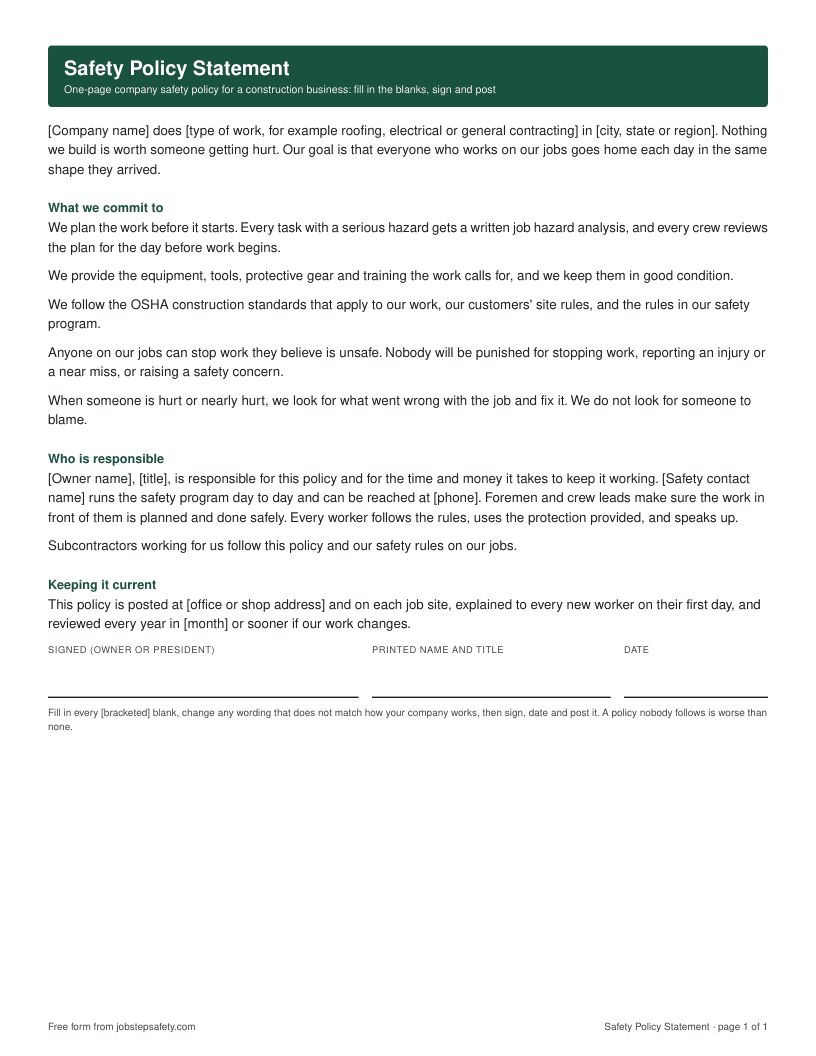
What is on the page
- Who you are: your company, the work you do and where.
- Five commitments: planning, equipment and training, OSHA standards, stop work and no retaliation, learning from injuries.
- Who is responsible: the owner, the safety contact with a phone number, foremen, workers and subcontractors.
- Keeping it current: where it is posted, new worker briefing and a yearly review.
- Signature lines for the owner, with the date.
What a safety policy is
A safety policy is a short, signed statement from the top of the company: what you promise about safety, who is responsible for keeping that promise, and what every worker can expect. It is not the rulebook. The rules, procedures and forms make up the safety program. The policy is the page in front of them that says why they exist and who stands behind them.
It matters more than its length suggests. A general contractor's safety director, an insurer or a prequalification reviewer reads it first, and a new worker hears it on day one. If the owner's name is on it and it matches how the company really works, it sets the tone for everything after it.
What OSHA asks for
No construction standard is titled safety policy. The general rule for construction employers puts the duty on the company to run whatever programs the standards require:
“It shall be the responsibility of the employer to initiate and maintain such programs as may be necessary to comply with this part.”
OSHA's recommended practices for construction safety programs then start with the policy. Its first action item for management is to put the commitment in writing:
“Establish a written policy signed by top management describing the organization's commitment to safety and health, and pledging to establish and maintain a safety and health program for all workers.”
The same guide says to share the policy with everyone the work touches: subcontractors, staffing agencies and temporary workers, suppliers, visitors and customers. [OSHA] Two lines in your policy also have rules behind them. Injury reporting: an employer must have a way for workers to report injuries promptly and accurately, and that way is not reasonable if it would discourage someone from reporting. [OSHA] And retaliation: the law bars discriminating against a worker for reporting an injury. [OSHA]
The template, word for word
This is the text in the free PDF and Word files. Replace each part in [brackets], change anything that does not match how your company works, and have the owner sign it.
Safety Policy Statement
[Company name] does [type of work, for example roofing, electrical or general contracting] in [city, state or region]. Nothing we build is worth someone getting hurt. Our goal is that everyone who works on our jobs goes home each day in the same shape they arrived.
What we commit to
We plan the work before it starts. Every task with a serious hazard gets a written job hazard analysis, and every crew reviews the plan for the day before work begins.
We provide the equipment, tools, protective gear and training the work calls for, and we keep them in good condition.
We follow the OSHA construction standards that apply to our work, our customers' site rules, and the rules in our safety program.
Anyone on our jobs can stop work they believe is unsafe. Nobody will be punished for stopping work, reporting an injury or a near miss, or raising a safety concern.
When someone is hurt or nearly hurt, we look for what went wrong with the job and fix it. We do not look for someone to blame.
Who is responsible
[Owner name], [title], is responsible for this policy and for the time and money it takes to keep it working. [Safety contact name] runs the safety program day to day and can be reached at [phone]. Foremen and crew leads make sure the work in front of them is planned and done safely. Every worker follows the rules, uses the protection provided, and speaks up.
Subcontractors working for us follow this policy and our safety rules on our jobs.
Keeping it current
This policy is posted at [office or shop address] and on each job site, explained to every new worker on their first day, and reviewed every year in [month] or sooner if our work changes.
The six parts of a good safety policy
- Who you are and what you do. One sentence: the company, the kind of work, where. A policy that could belong to anyone convinces nobody.
- The commitment. Plainly: people matter more than the schedule. Avoid slogans; write what you will actually do.
- The promises. Plan the work, provide the equipment and training, follow the standards, let anyone stop unsafe work, learn from injuries instead of blaming.
- Who is responsible. The owner by name, the person who runs safety day to day with a phone number, and what foremen and workers are each expected to do.
- Subcontractors and visitors. One line saying your policy applies to everyone on your jobs.
- Signature, date and review. Signed by the person in charge, dated, and reviewed every year. Say where it is posted.
Five example safety policies by trade
The opening of a policy is where it should sound like your company. Here are five opening paragraphs for different kinds of contractors. Use one as a starting point and keep the rest of the template.
Roofing contractor
Nobody works at an edge without protection. On every roof, before anyone goes up, we decide how each person is protected from a fall, and the foreman checks it is in place. A roofer who is not protected comes down, and nobody is penalised for saying so.
Electrical contractor
We treat every circuit as live until it has been locked out and tested dead. Every electrician carries the tools to test before touch, and no schedule is a reason to work a circuit hot when it could be shut off.
Remodeling company
Our crews work in people's homes, around families, pets and old materials nobody has tested. We plan each job for the dust, the cords and the tools we bring in, and we stop and ask before we disturb anything that might be lead, asbestos or mould.
Concrete and masonry
Silica dust, heavy loads and rebar are part of every job we run. We cut wet or with dust collection, we lift with equipment instead of backs where we can, and we cap every rebar end someone could fall onto.
Small general contractor
We are responsible for the site, not only our own crew. Every subcontractor gets our site rules before they start, hazards are shared at the morning meeting, and anyone on site can stop work they believe is unsafe, whoever they work for.
Five safety policies small contractors write next
The statement is page one. These are the policies general contractors and prequalification reviewers most often expect to find behind it:
- Stop work authority: anyone can stop unsafe work, and how work restarts.
- Injury and near miss reporting: how to report, to whom, how fast, and that nobody is punished for it. A free incident report form covers the paperwork.
- Job planning: when a job hazard analysis is written and how the crew reviews it each day.
- Personal protective equipment: what gear each task needs, who provides it, and how it is checked.
- New worker orientation: what every new hire hears before their first task, recorded on a safety orientation checklist.
Together with the hazard programs for your trade, the training records and the forms, these make up a written safety program.
Questions
Common questions
Is a written safety policy required by OSHA?
No OSHA construction standard requires a document called a safety policy. The construction rules do require employers to run the safety programs needed to comply (29 CFR 1926.20(b)), and OSHA's recommended practices for construction start with a written policy signed by top management. In practice, general contractors, insurers and prequalification services ask for one, so most contractors need it.
What is the difference between a safety policy and a safety program?
The policy is the one-page promise: what the company commits to and who is responsible, signed by the owner. The program is how the promise is kept: how jobs are planned, people trained, hazards fixed, incidents reported and reviewed. The policy usually sits on page one of the safety manual.
Who should sign the safety policy?
The person who runs the company: the owner, president or CEO. OSHA's recommended practices say the policy should be signed by top management, because it only means something if the person who controls the money and the schedule stands behind it.
Where should the safety policy be posted?
In the office or shop where notices to employees go, in each job trailer or site box, and in the front of your safety manual. Give it to every new worker during orientation and to subcontractors before they start.
How long should a safety policy be?
One page. If it runs longer, the extra is probably program detail that belongs in the manual. Short enough that a new worker reads it on day one.
How often should a safety policy be reviewed?
Once a year is common, and also whenever the company changes: new owner, new kind of work, a serious incident. Re-sign and re-date it each time so the date on the wall is current.
Sources
More safety program help
Also useful