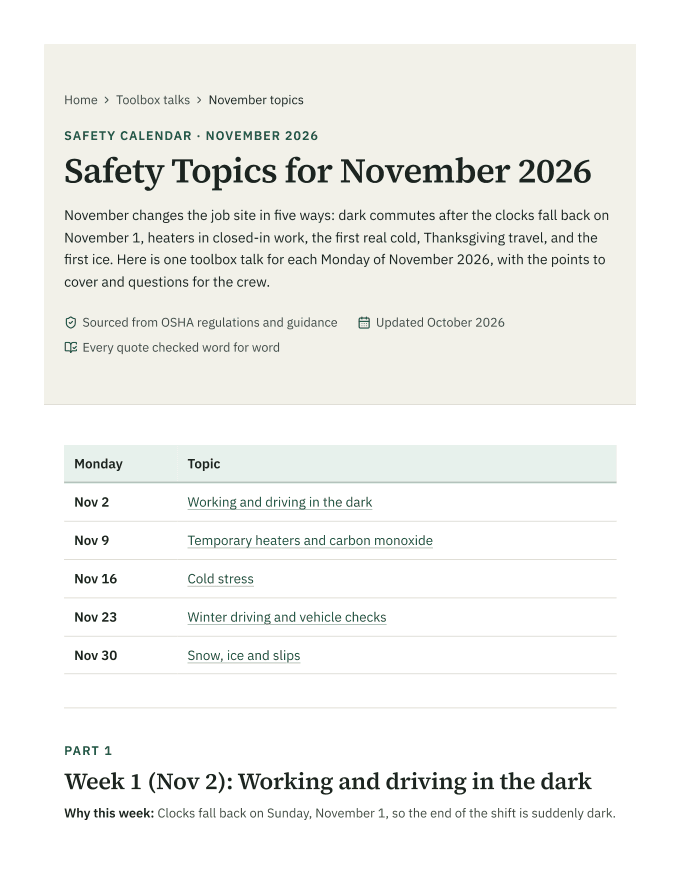
| Monday | Topic |
|---|---|
| Nov 2 | Working and driving in the dark |
| Nov 9 | Temporary heaters and carbon monoxide |
| Nov 16 | Cold stress |
| Nov 23 | Winter driving and vehicle checks |
| Nov 30 | Snow, ice and slips |
Week 1 (Nov 2): Working and driving in the dark
Why this week: Clocks fall back on Sunday, November 1, so the end of the shift is suddenly dark.
For the next few weeks, more of the shift happens in low light. Two OSHA points matter most.
Light the work. On construction sites the lighting rule applies whenever work is going on:
“Construction areas, ramps, runways, corridors, offices, shops, and storage areas shall be lighted to not less than the minimum illumination intensities listed in Table D-3 while any work is in progress”
| Area (29 CFR 1926.56, Table D-3) | Foot-candles |
|---|---|
| General construction area lighting | 5 |
| Concrete placement, excavation and waste areas, access ways, active storage, loading platforms, refueling and field maintenance areas | 3 |
| Indoor warehouses, corridors, hallways and exitways | 5 |
| Shops and plant: batch plants, equipment rooms, carpenter shops, mess halls, indoor toilets | 10 |
| First aid stations and offices | 30 |
Be seen near traffic. More of the shift now happens near traffic in poor light, and OSHA is direct about vests:
“Workers exposed to vehicular traffic should wear the appropriate high visibility vest at all times, so that they can be visible to motorists”
And the drive home counts. OSHA reports that on average 39% of all work fatalities are transportation incidents. [OSHA]
Ask the crew:
- Which parts of this site are dark at start or finish time now, and what light do we need there?
- Who works near traffic, and is their vest clean and visible?
Week 2 (Nov 9): Temporary heaters and carbon monoxide
Why this week: Heaters come out as buildings are closed in for winter.
Heaters keep crews and curing concrete warm, but they burn fuel next to people and materials. On construction sites 29 CFR 1926.154 sets the rules. The key points:
- Fresh air. Enough fresh air must reach the work; if natural air is not enough, add mechanical ventilation. Take special care in confined spaces. [OSHA]
- Clearance. A radiant room heater needs 36 inches from combustible material at the sides and rear; a circulating type needs 12 inches, unless the heater is listed for less. [OSHA]
- Tarps. Keep heaters at least 10 feet from combustible tarps or canvas, and fasten the covers so wind cannot blow them onto the heater or knock it over. [OSHA]
- Level and on the right base. Set heaters level, and do not stand a heater that is not suitable for wood floors directly on wood. [OSHA]
- No solid fuel salamanders inside buildings or on scaffolds. [OSHA]
The hazard you cannot see is carbon monoxide:
“Carbon monoxide (CO) is a poisonous, colorless, odorless and tasteless gas.”
Early signs are tightness across the chest, headache, tiredness, dizziness, drowsiness or nausea. [OSHA] OSHA tells employers to keep gasoline engines and tools out of poorly ventilated areas, keep heaters in good working order, and give workers personal CO monitors with alarms where exposure is possible. [OSHA] If someone may be poisoned, move them to fresh air and call 911. [OSHA]
Ask the crew:
- Where are heaters running on this site, and how far are they from tarps and stored material?
- Is anything with a gas engine running inside? Where does its exhaust go?
Week 3 (Nov 16): Cold stress
Why this week: The first hard cold snaps catch crews who are not dressed for them yet.
Cold stress gets its own full talk: the four cold injuries, what to wear, and OSHA's first aid. Use the cold weather toolbox talk this week. The three points to land if you are short on time:
Week 4 (Nov 23): Winter driving and vehicle checks
Why this week: Thanksgiving week: holiday travel on top of work driving.
Many people drive further this week. For work vehicles, OSHA says trained workers should check these systems before winter: [OSHA]
- Brakes, and brake fluid level
- Cooling system: a 50/50 mix of antifreeze and water at the right level
- Battery charge, clean connections, alternator belt
- Tires: tread depth, damage, pressure
- Lights, defrosters and wipers (fit winter wipers)
Keep an emergency kit in the vehicle: phone or radio, ice scraper, snow brush, flashlight with spare batteries, tow chain, sand or cat litter for traction, flares, jumper cables, road maps, blankets and a change of clothes. [OSHA]
If you get stranded, OSHA's advice is to stay with the vehicle:
“Do not leave the vehicle to search for assistance unless help is visible within 100 yards.”
“Beware of carbon monoxide poisoning. Keep the exhaust pipe clear of snow, and open a downwind window slightly for ventilation.”
Ask the crew:
- Who is driving a long way this week, and is their vehicle ready?
- What is in your vehicle kit right now?
Week 5 (Nov 30): Snow, ice and slips
Why this week: The first snow and ice of the season.
OSHA tells employers to clear walking surfaces of snow and ice and spread deicer as soon as possible after a storm. [OSHA] For the crew:
- Wear insulated, water resistant boots with good rubber treads. [OSHA]
- Take short steps and walk slower on ice or snow, so you can react when your footing changes. [OSHA]
- Shoveling: warm up first, lift small amounts, push snow instead of lifting where you can, keep your back straight and lift with your legs, and do not twist. [OSHA]
Snow on roofs and other surfaces adds two hazards you cannot see from the ground:
“A surface that is weighed down by snow must be inspected by a competent person to determine if it is structurally safe for workers to access it, because it may be at risk of collapsing. Snow covered rooftops can hide hazards such as skylights that workers can fall through.”
Ask the crew:
- Which walkways and ramps on this site ice over first, and who clears them?
- Is anyone going on a roof this month? Who checks it first?