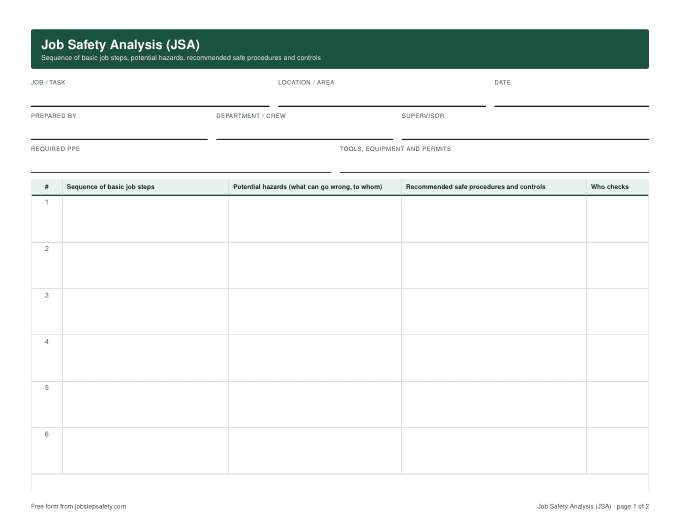
Planning a single task on site and want a one-page sheet with a pre-job checklist and crew sign-off? Use the printable JSA form instead.
What is on the form
| On the form | What goes there |
|---|---|
| Job / task, location, date | The job as the crew names it, where it is done, and the date the analysis was written or last revised. |
| Prepared by, crew, supervisor | Who wrote it, which crew does the job, and who signs it off. OSHA says to include the employees in every phase, from listing the steps to agreeing the controls. [OSHA] |
| Required PPE; tools, equipment, permits | Listed once at the top so a reader sees in one glance what the job needs before it starts. |
| Sequence of basic job steps | One row per step, in order. OSHA's method is to watch the job and list each step as the worker takes it, then check the list with them. [OSHA] |
| Potential hazards | What can go wrong in that step and to whom. OSHA's starting questions are what can go wrong, what the consequences are, how it could arise, what else contributes, and how likely it is. [OSHA] |
| Recommended safe procedures and controls | What removes or reduces each hazard, with engineering controls ahead of procedures and PPE. [OSHA] |
| Who checks | A short column we added: the person who confirms the control is in place before the step starts. Many JSA layouts leave this out and the controls stay on paper. |
| Reviewed with crew, next review | The sign-off line, and the date or trigger for the next look. |
How to write each column
Column 1: sequence of basic job steps
Watch the job and list the steps as the worker takes them, in order. [OSHA] Keep each step to one action, and keep the list short enough to use. OSHA's test for the right grain:
“Be sure to record enough information to describe each job action without getting overly detailed.”
Column 2: potential hazards
Describe each hazard so a new hire can picture it: where it happens, who is exposed, what sets it off and what the injury would be. [OSHA] "Could drop the 15-pound casting on his foot" is a hazard. "Manual handling" is a category. Write the hazard.
Column 3: recommended safe procedures and controls
OSHA ranks controls. Engineering controls that physically change the machine or the workplace come first, administrative controls that change how people work come second, and PPE comes third. [OSHA]If a row has nothing but PPE in it, look again. OSHA also notes that training is weak against hazards that strike too quickly for anyone to react. [OSHA]
Then review it
Discuss the controls with everyone who performs the job and consider their responses. [OSHA]Review the whole JSA periodically, after any injury or illness linked to that job, and after a close call caused by someone not following the steps. [OSHA] When it changes, train the people the change affects. [OSHA]
Example row, from OSHA's own analysis
OSHA 3071 analyzes grinding iron castings in a metal shop. Its second hazard for the first step maps onto the three columns like this. The hazard and the controls are OSHA's words; the step wording is ours, condensed from OSHA's task description.
- Reach into the metal box, grasp a 15-pound casting and carry it to the grinding wheel.
“Castings have sharp burrs and edges that can cause severe lacerations.”
“1. Use a device such as a clamp to pick up castings. 2. Wear cut-resistant gloves that allow a good grip and fit tightly to minimize the chance that they will get caught in grinding wheel.”
- Lead hand confirms clamp and gloves at the grinder before the first casting.
The same step has two more hazards in OSHA's example, dropping the casting on a foot and straining the lower back lifting from the floor, each with its own controls. [OSHA] Give each hazard its own row rather than cramming three into one cell.