JobStep Safety

Paid pack · PDF and Word

A year of toolbox talks, planned and ready to read

52 weekly safety talks for construction crews, in season order: cold stress in January, trenches in spring, heat in summer, heaters and winter driving in the fall. Each one has the points to cover, questions for the crew, a one-minute version and a sign-in sheet.

  • 52 talks, one for every week
  • Every point names its OSHA source
  • Sign-in sheet on every talk
  • Instant download after checkout

Year of Toolbox Talks

$19

One payment. Yours to keep and print.

  • Secure checkout by Stripe
  • Download links also sent by email
  • Not right for you? Refund within 14 days

Planned for the seasons

The right hazard at the right time of year.

Five minutes each

Plus a one-minute version for quick huddles.

Crew questions

Two or three per talk, so the crew does the talking.

Sign-in sheets

A record of who attended, on every talk.

Three full sample talks

Read them before you buy

One from winter, spring and summer, exactly as they appear in the pack (minus the sign-in sheet).

Week 2 · any workplace

Slips on ice and snow

A patch of ice does not care how experienced you are. The walk from the truck, the steps, and the edges of the site nobody cleared are where it gets you. This week is about walking, clearing and shoveling without getting hurt.

Cover these points

  1. Clear walkways of snow and ice and spread deicer as soon as you can after a storm. The walking routes come first: parking, site entrances, stairs and the paths between work areas. (OSHA)
  2. Wear boots that are insulated, water resistant and have good rubber treads. If you have to walk on snow or ice in regular shoes, keep a pair of rubber over-shoes with treads that fit over them. (OSHA)
  3. On an icy or snow-covered path, take short steps and walk slower than usual so you can react when the traction changes under you. (OSHA)
  4. Shoveling is heavy work in cold air and can lead to exhaustion, back injury or even a heart attack. Warm up first, scoop small amounts, and push the snow instead of lifting it when you can. When you must lift: back straight, lift with the legs, and do not turn or twist your body. (OSHA)
  5. Plan around the weather. Watch conditions during a storm, keep a reliable way to reach every worker, and be ready to stop work or send people in. Where possible schedule the cold, exposed jobs for the warmest part of the day. (OSHA)
  6. Spreading de-icing material on a roof can put workers at risk of falling through skylights. OSHA points to aerial lifts or ladders as a way to apply it and protect workers from that hazard. (OSHA)

“Take short steps and walk at a slower pace so you can react quickly to a change in traction, when walking on an icy or snow-covered walkway.”

OSHA

Ask the crew

  • Which paths on this site still have ice on them right now, and who is clearing them?
  • Look at your boots. Do they have real tread, and are they waterproof?
  • If we get snow at lunch, how does the crew find out whether we keep working?

One-minute version

Clear and salt the walking routes first, not last. Boots with rubber treads, short steps, slower pace. If you shovel, warm up, push instead of lift, and never twist with a loaded shovel. Nobody walks a snowy roof to spread de-icer; use a lift or ladder.
Week 19 · construction

Trenches and cave-ins

A cave-in gives no warning and buries a person in seconds. The protection rules are simple, and they are what stands between the crew and the walls.

Cover these points

  1. A trench 5 feet deep or more needs a protective system against cave-ins. The options are sloping or benching the walls, shoring them, or setting a shield such as a trench box. The only exception is a dig made entirely in stable rock. Under 5 feet, a competent person may decide no system is needed, but only after examining the ground. (OSHA)
  2. At 20 feet deep or more, the protective system must be designed by a registered professional engineer, or built from tabulated data a registered professional engineer prepared or approved. That is not a foreman decision. (OSHA)
  3. A competent person inspects the trench, the ground next to it and the protective system before work starts, as needed through the shift, and after every rainstorm or other event that raises the risk. If there is any sign of a possible cave-in, everyone comes out until it is fixed. (OSHA)
  4. Spoil piles, materials and equipment stay at least 2 feet back from the edge, or are held back by retaining devices. Weight on the lip is what pushes a wall in. (OSHA)
  5. In a trench 4 feet or deeper, there is a ladder, stairway or ramp within 25 feet of lateral travel for every worker. You should never have to walk more than that to get out. (OSHA)
  6. Do not work in a trench where water has collected or is collecting unless precautions are in place to handle it. And nobody stands under a load handled by digging or lifting equipment; stand clear of any vehicle being loaded. (OSHA)

“It only takes seconds to become buried in thousands of pounds of soil.”

OSHA

Ask the crew

  • How deep is the trench today, and what protective system is in it?
  • Who is the competent person, and when was the last inspection?
  • Where is the nearest ladder from the spot you will be working?

One-minute version

Five feet deep means a protective system: slope, bench, shore or shield. A competent person inspects before every shift and after every rain. Spoil stays 2 feet back from the edge, and a ladder is within 25 feet of you. If you see cracks, water or a bulging wall, get out and say so.

Week 27 · any workplace

Heat: water, rest and shade

Summer heat sends workers to the hospital every year, and most of it is preventable. The fix is simple and it starts today: drink before you are thirsty, take the breaks, and get out of the sun to cool down.

Cover these points

  1. Drink cool water often while you work, not just when you feel thirsty. Thirst comes late. Keep drinking on a regular schedule through the whole shift and after it. (OSHA)
  2. Water has to be close to the work, easy to reach, and there has to be enough of it for the whole job. If you cannot find the water, tell the foreman before you start, not after. (OSHA)
  3. On jobs that run more than two hours, water alone is not enough. Sweat takes salt and other electrolytes with it, and losing too much can bring on cramps and worse. That is what sports drinks are for. (OSHA)
  4. When it gets hot, breaks are required, and they get longer and more frequent as the heat goes up. Skipping a break in the heat is not toughness. OSHA says plainly that it is not safe. (OSHA)
  5. Rest somewhere cool: a shady spot, an air-conditioned truck, a tent, or an area with fans and misters. If there is no cool place to rest, the break has to run longer so your body can recover. (OSHA)
  6. Plan the day around the heat. Put the hard physical work in the morning, slow the pace, and use shorter shifts with frequent rest breaks in the shade or away from heat sources. (OSHA)

“Workers should not rely on feeling thirsty to prompt them to drink.”

OSHA

Ask the crew

  • Where is the water on this site today, and who is in charge of keeping it full and cool?
  • Where is our cool rest area, and is it close enough that people will actually use it?
  • Which tasks today are the heaviest, and can we move them earlier in the day?

One-minute version

Heat is a hazard like any other, and the controls are water, rest and shade. Drink on a schedule, not when you feel thirsty, and use the sports drinks on long jobs. Take every break, rest in a cool place, and we put the hardest work in the morning. If you feel off, say so.

Inside the PDF

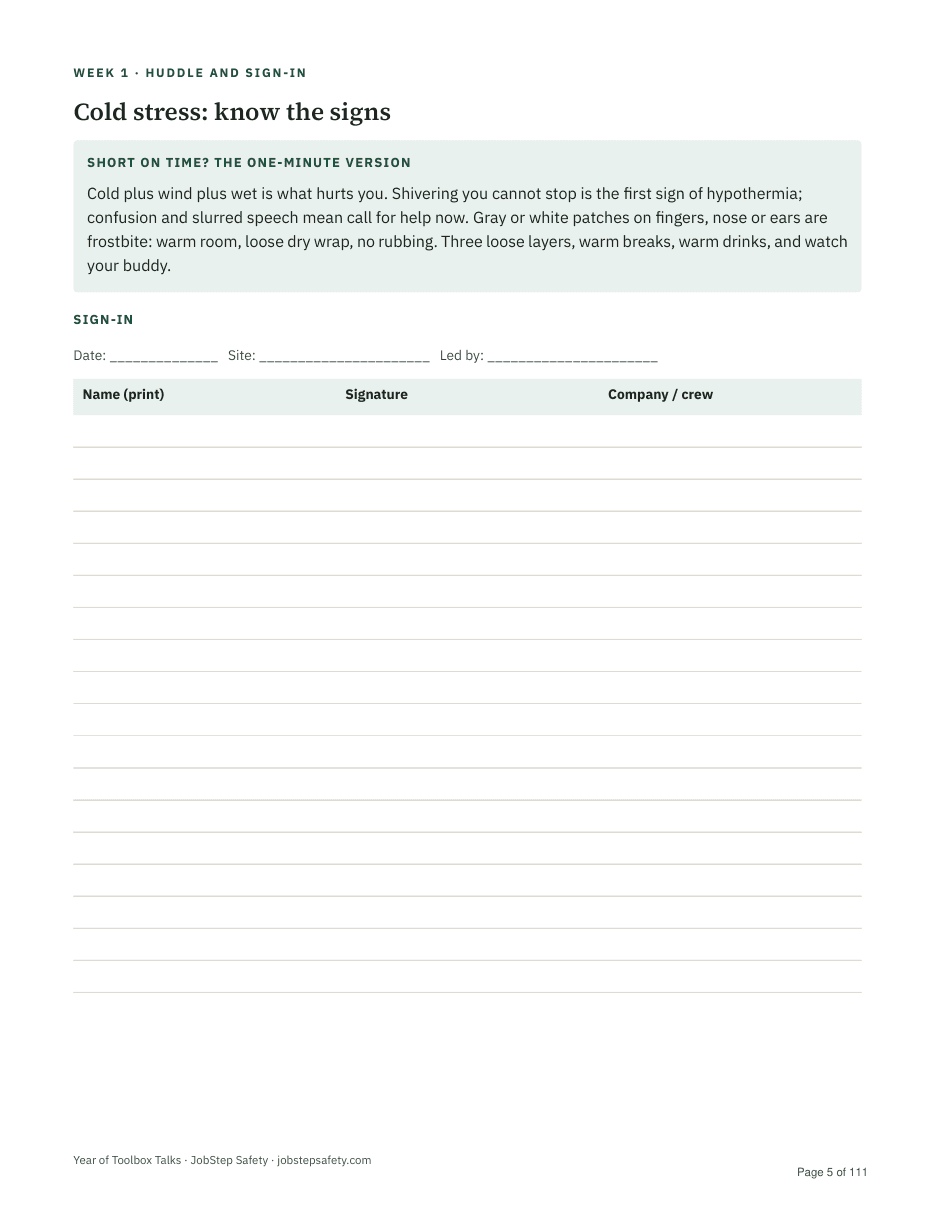
Two pages per week: the talk, then the huddle and sign-in

Year of Toolbox Talks: Cover
Cover
Year of Toolbox Talks: The year at a glance
The year at a glance
Year of Toolbox Talks: Page 1: the talk
Page 1: the talk
Year of Toolbox Talks: Page 2: one-minute version and sign-in
Page 2: one-minute version and sign-in

All 52 weeks

What is inside

Winter

  1. 1Cold stress: know the signs
  2. 2Slips on ice and snow
  3. 3Carbon monoxide from heaters and engines
  4. 4Ladders: setting up and climbing
  5. 5Housekeeping and debris
  6. 6Chemical labels and safety data sheets
  7. 7Eye and face protection
  8. 8Power tool guards
  9. 9Extension cords and GFCIs
  10. 10Fire extinguishers on site
  11. 11Lifting and carrying
  12. 12Falling objects
  13. 13Noise and hearing protection

Spring

  1. 14Fall protection: when it is required
  2. 15Inspecting your harness and lanyard
  3. 16Guardrails, holes and covers
  4. 17Scaffolds: check before you climb
  5. 18Aerial lifts
  6. 19Trenches and cave-ins
  7. 20Underground utilities before digging
  8. 21Heavy equipment blind spots and backing
  9. 22Working near traffic
  10. 23Silica dust
  11. 24Deenergizing and tagging circuits
  12. 25Overhead power lines
  13. 26Lightning

Summer

  1. 27Heat: water, rest and shade
  2. 28Heat illness: signs and first aid
  3. 29New and returning workers in the heat
  4. 30Hand protection and gloves
  5. 31Hand tools
  6. 32Air tools and hoses
  7. 33Welding and cutting: fire prevention
  8. 34Compressed gas cylinders
  9. 35Flammable liquids and fuels
  10. 36Confined spaces
  11. 37Forklifts
  12. 38Cranes: signals and power lines
  13. 39Hard hats

Fall and early winter

  1. 40First aid and emergencies on site
  2. 41Respirators: when and how
  3. 42Lead in renovation work
  4. 43Stairways on site
  5. 44Working in low light
  6. 45Temporary heaters
  7. 46Winter driving and vehicle checks
  8. 47Fatigue and long hours
  9. 48Your right to raise safety concerns
  10. 49Reporting injuries
  11. 50Clearing snow from roofs
  12. 51Snow blowers, chainsaws and downed lines
  13. 52Looking back: near misses and lessons

Questions

Common questions, short answers

Something not covered here? Email help@jobstepsafety.com and we will answer.

What format is it?

One PDF to print and one Word file you can edit. In the PDF each talk takes two pages: the talk, then the one-minute version and a sign-in sheet.

How long is each talk?

About five minutes to read aloud, plus the crew questions. Each one also has a one-minute version for a quick huddle.

Where does the content come from?

Every point names its source: OSHA standards, OSHA publications and OSHA topic pages. Quotes are checked word for word against the saved text.

Is it only for construction?

It is written for construction crews. Each talk is labeled construction or any workplace, so you can see which rules it follows.

What if it is not right for me?

Email us within 14 days of purchase and we refund you in full, one refund per customer. You can also read three full sample talks on this page before you buy.

Do I have to start in January?

No. Week 1 is the first week of January and topics follow the seasons, but you can start with whatever week fits your site now.

Your next 52 safety meetings, done