How to read these examples
Each table has the three columns OSHA's own JSA worksheet uses: the job step, the hazards of that step, and the safe job procedures. [OSHA] The difference here is the fourth element in the control column: the paragraph of the standard that contains the duty. Five tasks are construction work under 29 CFR 1926. The forklift example is general industry under 29 CFR 1910.178, and the table says so. The step order is a common sequence, not a rule; your job may add or drop steps.
These examples are a starting point for your own JSA, not a replacement for it. OSHA's advice on using its standards this way:
“Compliance with these standards is mandatory, and by incorporating their requirements in your job hazard analysis, you can be sure that your health and safety program meets federal standards.”
1. Confined space entry (construction, 1926 Subpart AA)
Subpart AA covers confined spaces on construction sites: bins, pits, manholes, tanks, HVAC ducts, sewers and the like. [OSHA] It does not cover excavation work, which Subpart P regulates, or underground construction and diving. [OSHA] A permit-required confined space is one that has or could have a hazardous atmosphere, an engulfment hazard, inwardly converging walls or a sloping floor that could trap someone, or any other recognized serious hazard. [OSHA] The testing order below is one of the few places the rule gives a sequence:
“When testing for atmospheric hazards, test first for oxygen, then for combustible gases and vapors, and then for toxic gases and vapors;”
| # | Job step | Hazard | Control (paragraph) |
|---|---|---|---|
| 1 | Before work starts: survey the site for confined spaces | A space is entered without anyone knowing it is a permit space | A competent person identifies every confined space employees may work in and decides which are permit spaces, testing as necessary (1926.1203(a)) [OSHA]. Post danger signs or give equally effective warning of each permit space (1926.1203(b)(1)) [OSHA]. |
| 2 | Decide to enter: set up the program and permit | Entry without a plan for the specific hazards of this space | Have a written permit space program in place at the site before entry (1926.1203(d)) [OSHA]. Identify and evaluate the hazards of the space before employees enter (1926.1204(b)) [OSHA]. Run a system for preparing, issuing, using and cancelling entry permits (1926.1204(j)) [OSHA]. |
| 3 | Isolate and ventilate | Energy, engulfment or atmosphere hazards still live inside the space | Isolate the space and the physical hazards within it (1926.1204(c)(3)) [OSHA]. Purge, inert, flush or ventilate as necessary to eliminate or control atmospheric hazards (1926.1204(c)(4)) [OSHA]. Eliminate any condition, such as high pressure, that makes removing the entrance cover unsafe (1926.1204(c)(8)) [OSHA]. |
| 4 | Test the atmosphere | Oxygen deficiency, flammable gas or toxic vapor not detected | Test before entry and in the order the rule sets: oxygen first, then combustible gases and vapors, then toxic gases and vapors (1926.1204(e)(3)) [OSHA]. Give each entrant the chance to observe the testing (1926.1204(e)(4)) [OSHA] and give them the results immediately (1926.1204(e)(6)) [OSHA]. |
| 5 | Enter and work | Entrant in trouble with nobody outside to notice or act | Station at least one attendant outside the space for the whole entry (1926.1204(f)) [OSHA]. Monitor atmospheric hazards continuously unless the rule's exceptions apply (1926.1204(e)(2)) [OSHA]. Entrants alert the attendant at any warning sign or prohibited condition (1926.1208(d)) [OSHA] and leave at once when ordered, alarmed, or when they notice symptoms (1926.1208(e)) [OSHA]. |
| 6 | Be ready to rescue | Would-be rescuers enter and become victims | Have procedures for summoning rescue, rescuing entrants, giving emergency care and stopping unauthorized rescue attempts (1926.1204(i)) [OSHA]. Non-entry rescue is required unless retrieval equipment would add risk or not help; each entrant then wears a chest or full body harness with a retrieval line attached outside (1926.1211(c), (c)(1), (c)(2)) [OSHA]. |
2. Welding and cutting (construction, 1926 Subpart J)
Subpart J splits the rules by process: gas welding and cutting (1926.350), arc welding (1926.351), fire prevention for all hot work (1926.352), and ventilation and protection (1926.353). The fire rule is short and absolute:
“Suitable fire extinguishing equipment shall be immediately available in the work area and shall be maintained in a state of readiness for instant use.”
| # | Job step | Hazard | Control (paragraph) |
|---|---|---|---|
| 1 | Move and set up gas cylinders | Cylinder falls, valve is knocked off, or cylinder becomes part of a circuit | Keep cylinders secured upright at all times except briefly while being hoisted or carried (1926.350(a)(9)) [OSHA], with valve protection caps in place and secured (1926.350(a)(1)) [OSHA]. Place cylinders where sparks, hot slag or flame cannot reach them, or shield them (1926.350(b)(1)) [OSHA], and where they cannot become part of an electrical circuit (1926.350(b)(2)) [OSHA]. Never take oxygen or fuel gas cylinders into a confined space (1926.350(b)(4)) [OSHA]. |
| 2 | Inspect hose, torch and cables at the start of the shift | Leaking hose or torch, worn welding cable | Inspect all gas hose at the beginning of each shift and remove defective hose (1926.350(f)(3)) [OSHA]; inspect torches each shift for leaking valves, couplings and tip connections (1926.350(g)(2)) [OSHA]. Do not use arc welding cable that needs repair (1926.351(b)(4)) [OSHA]; report faulty equipment to the supervisor (1926.351(d)(4)) [OSHA]. |
| 3 | Prepare the area for hot work | Fire from sparks, slag or heat reaching combustibles | Move the work to a safe location if practical; otherwise move or protect the movable fire hazards (1926.352(a)) [OSHA], and confine heat, sparks and slag from the ones that cannot move (1926.352(b)) [OSHA]. Keep fire extinguishing equipment immediately available and ready (1926.352(d)) [OSHA]. Where normal precautions are not enough, assign someone to watch for fire while the work goes on and afterward (1926.352(e)) [OSHA]. |
| 4 | Light up and weld or cut | Eye injury, arc flash to others, fumes | Every welder, cutter or heater wears suitable eye protection (1926.353(e)(2)) [OSHA]. Shield arc welding with noncombustible or flameproof screens whenever practicable (1926.351(e)) [OSHA]. Light torches with friction lighters, not matches or hot work (1926.350(g)(3)) [OSHA]. In a confined space provide mechanical ventilation (1926.353(b)(1)) [OSHA]; for zinc, lead, cadmium or chromium bearing metals in enclosed spaces, ventilation is required (1926.353(c)(1)) [OSHA]. |
| 5 | Stop work or leave the area | Live electrode holder left out; gas leaking from an idle torch | Remove electrodes from unattended holders and place holders so they cannot contact people or conductive objects (1926.351(d)(1)) [OSHA]; open the power supply switch when leaving or moving the machine (1926.351(d)(3)) [OSHA]. Close the cylinder valve when work is finished or the cylinder is moved (1926.350(a)(8)) [OSHA]. |
3. Electrical work (construction, 1926 Subpart K)
This example is construction only. The duty that shapes the whole JSA comes before any tool is picked up:
“Before work is begun the employer shall ascertain by inquiry or direct observation, or by instruments, whether any part of an energized electric power circuit, exposed or concealed, is so located that the performance of the work may bring any person, tool, or machine into physical or electrical contact with the electric power circuit.”
| # | Job step | Hazard | Control (paragraph) |
|---|---|---|---|
| 1 | Before work: find every circuit in the work area | Contact with an energized circuit nobody knew was there | Find out by inquiry, direct observation or instruments whether any energized circuit, exposed or concealed, is where the work could bring a person, tool or machine into contact with it; post warning signs and tell employees the location, hazards and protective measures (1926.416(a)(3)) [OSHA]. Where underground lines are of unknown location, give workers using jackhammers, bars or similar hand tools insulated protective gloves (1926.416(a)(2)) [OSHA]. |
| 2 | Deenergize or guard the circuit | Shock or electrocution while working near live parts | Do not let an employee work close enough to contact a circuit unless it is deenergized and grounded, or effectively guarded by insulation or other means (1926.416(a)(1)) [OSHA]. |
| 3 | Lock out and tag | Someone re-energizes the circuit while work is under way | Tag the controls that will be deactivated (1926.417(a)) [OSHA]. Render deenergized equipment and circuits inoperative and tag them at every point where they could be energized (1926.417(b)) [OSHA]. Tags must plainly identify the equipment or circuit being worked on (1926.417(c)) [OSHA]. |
| 4 | Do the work | Damaged cords, cords across walkways, live fuse handling | Do not use worn or frayed cords or cables (1926.416(e)(1)) [OSHA]; do not fasten extension cords with staples, nails or wire (1926.416(e)(2)) [OSHA]. Keep working spaces and walkways clear of cords (1926.416(b)(2)) [OSHA]. Use insulated special tools when installing or removing fuses with a terminal energized (1926.416(d)) [OSHA]. |
| 5 | Keep others out | Passers-by walk into an open electrical workspace | Provide barriers or other guarding so the workspace is not used as a passageway while energized parts are exposed (1926.416(b)(1)) [OSHA]. |
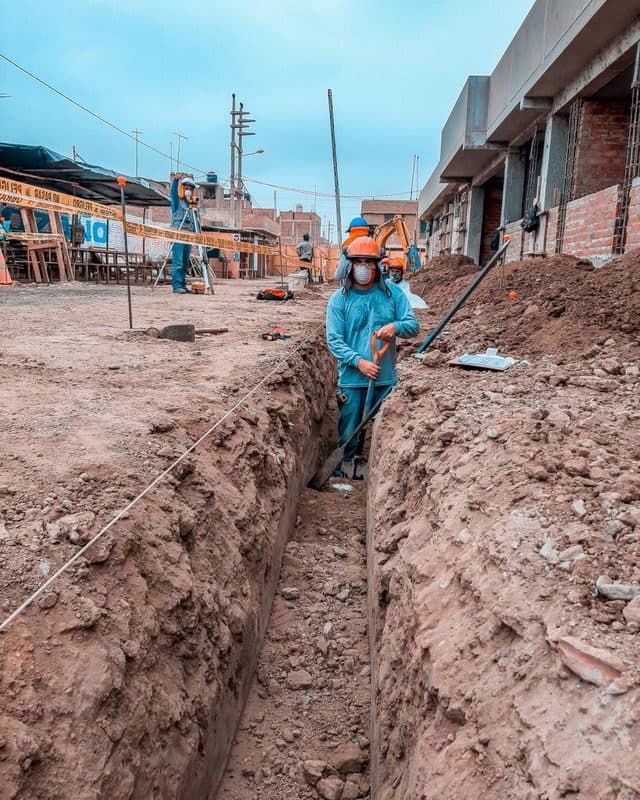
4. Excavation and trenching (construction, 1926 Subpart P)
Subpart P has two working sections: 1926.651 for the specific requirements around the dig (utilities, access, spoil, water, inspections) and 1926.652 for the protective system against cave-ins. The cave-in rule applies to every excavation except two cases:
“Excavations are less than 5 feet (1.52m) in depth and examination of the ground by a competent person provides no indication of a potential cave-in.”
(The other exception is an excavation made entirely in stable rock. [OSHA]) The inspection duty is also specific about timing:
“An inspection shall be conducted by the competent person prior to the start of work and as needed throughout the shift. Inspections shall also be made after every rainstorm or other hazard increasing occurrence.”
| # | Job step | Hazard | Control (paragraph) |
|---|---|---|---|
| 1 | Before opening the ground: locate utilities | Striking a gas, electric, water or sewer line | Determine the estimated location of underground installations before opening the excavation (1926.651(b)(1)) [OSHA] and contact the utility owners to mark them before digging starts (1926.651(b)(2)) [OSHA]. As the dig approaches the estimated location, find the exact location by safe and acceptable means (1926.651(b)(3)) [OSHA]. |
| 2 | Dig and place the spoil | Spoil or equipment rolling back into the trench; workers under buckets | Keep excavated material and equipment at least 2 feet from the edge, or use retaining devices (1926.651(j)(2)) [OSHA]. Nobody works under loads handled by lifting or digging equipment (1926.651(e)) [OSHA]. Use a warning system such as barricades or stop logs when mobile equipment works near the edge without a clear view of it (1926.651(f)) [OSHA]. |
| 3 | Install the protective system | Cave-in | Protect each employee in the excavation with a sloping, benching, shoring or shield system designed under 1926.652(b) or (c), unless the dig is entirely in stable rock or is less than 5 feet deep and a competent person finds no indication of a potential cave-in (1926.652(a)(1)) [OSHA]. Keep workers out of shields while they are installed, removed or moved vertically (1926.652(g)(1)(iv)) [OSHA]. |
| 4 | Enter and work in the trench | No way out; bad air; water | In trenches 4 feet or deeper, provide a stairway, ladder, ramp or other safe exit within 25 feet of lateral travel (1926.651(c)(2)) [OSHA]. Where a hazardous atmosphere could reasonably exist, test the air before entry into excavations deeper than 4 feet (1926.651(g)(1)(i)) [OSHA]. Do not work where water is accumulating unless adequate precautions are in place (1926.651(h)(1)) [OSHA]. Wear high-visibility vests when exposed to public traffic (1926.651(d)) [OSHA]. |
| 5 | Inspect through the shift | Conditions change after rain, vibration or time | A competent person inspects the excavation, adjacent areas and protective systems daily, before work starts, as needed through the shift and after every rainstorm (1926.651(k)(1)) [OSHA], and removes exposed employees when there is evidence of a possible cave-in or other hazard until precautions are taken (1926.651(k)(2)) [OSHA]. |
5. Forklift operation (general industry, 1910.178)
Forklifts are powered industrial trucks. In general industry the rule is 1910.178, and the controls below cite it. On a construction site the equipment rule is 1926.602, which posts the rated capacity on the truck and forbids modifications that affect capacity without the maker's written approval, [OSHA] and for operator training says:
“The requirements applicable to construction work under this paragraph are identical to those set forth at §1910.178(l) of this chapter.”
So the training rows below hold on construction sites too. The parking rule is the one most often skipped:
“When a powered industrial truck is left unattended, load engaging means shall be fully lowered, controls shall be neutralized, power shall be shut off, and brakes set. Wheels shall be blocked if the truck is parked on an incline.”
| # | Job step | Hazard | Control (paragraph) |
|---|---|---|---|
| 1 | Before the shift: operator and truck | Untrained operator; defective truck | Only an operator who has completed the required training and evaluation drives the truck (1910.178(l)(1)(i), (l)(1)(ii)) [OSHA]. Examine the truck before it is placed in service, at least daily, or after each shift on round-the-clock use (1910.178(q)(7)) [OSHA]. Take any truck that is defective or unsafe out of service until repaired (1910.178(p)(1)) [OSHA]. |
| 2 | Pick up the load | Unstable or overweight load; tip-over | Handle only stable or safely arranged loads (1910.178(o)(1)) [OSHA] within the truck's rated capacity (1910.178(o)(2)) [OSHA]. Place the forks under the load as far as possible and tilt the mast back carefully to stabilize it (1910.178(o)(5)) [OSHA]. Use a load backrest extension where needed to stop the load falling rearward (1910.178(m)(10)) [OSHA]. |
| 3 | Travel | Striking pedestrians; blind corners; grades | Keep about three truck lengths from the truck ahead and the truck under control at all times (1910.178(n)(1)) [OSHA]. Slow down and sound the horn at cross aisles and where vision is obstructed; if the load blocks the view, travel with the load trailing (1910.178(n)(4)) [OSHA]. Drive at a speed that lets you stop safely (1910.178(n)(8)) [OSHA]. On grades over 10 percent, keep a loaded truck's load upgrade (1910.178(n)(7)(i)) [OSHA]. Nobody stands or passes under the elevated part of the truck (1910.178(m)(2)) [OSHA]. |
| 4 | Set down and leave the truck | Runaway or rolling truck; raised forks | When the truck is left unattended, fully lower the forks, neutralize the controls, shut off power and set the brakes; block the wheels on an incline (1910.178(m)(5)(i)) [OSHA]. Within 25 feet and in view, still lower the forks, neutralize controls and set the brakes (1910.178(m)(5)(iii)) [OSHA]. |
| 5 | Refuel or recharge | Fire from fuel spill or open flame | Do not fill fuel tanks with the engine running (1910.178(p)(2)) [OSHA]; wash away or evaporate spills and replace the cap before restarting (1910.178(p)(3)) [OSHA]. Never check battery electrolyte or fuel level with an open flame (1910.178(p)(5)) [OSHA]. |
6. Scaffold work (construction, 1926 Subpart L)
Subpart L puts the capacity, platform, access, use and fall protection rules in 1926.451 and the training rules in 1926.454. Two duties anchor the JSA, the fall protection height and the daily inspection:
“Each employee on a scaffold more than 10 feet (3.1 m) above a lower level shall be protected from falling to that lower level.”
“Scaffolds and scaffold components shall be inspected for visible defects by a competent person before each work shift, and after any occurrence which could affect a scaffold's structural integrity.”
| # | Job step | Hazard | Control (paragraph) |
|---|---|---|---|
| 1 | Erect the scaffold | Collapse from poor footing, overload or wrong assembly | Erect, move, dismantle or alter only under the supervision of a competent person, using trained employees selected for that work (1926.451(f)(7)) [OSHA]. Each scaffold and component must carry its own weight and at least 4 times the maximum intended load (1926.451(a)(1)) [OSHA]. Poles, legs and frames bear on base plates and mud sills or another firm foundation (1926.451(c)(2)) [OSHA]. Keep the clearances from power lines set in 1926.451(f)(6) (1926.451(f)(6)) [OSHA]. |
| 2 | Get on and off | Fall while climbing the frame | When the platform is more than 2 feet above or below the point of access, use a ladder, stair tower, ramp or other listed means of access; crossbraces are not a means of access (1926.451(e)(1)) [OSHA]. |
| 3 | Work on the platform | Fall from the platform; fall through gaps | Fully plank or deck every working level between the uprights and guardrail supports (1926.451(b)(1)) [OSHA]. Protect each employee more than 10 feet above a lower level from falling (1926.451(g)(1)) [OSHA]. Do not load the scaffold beyond its maximum intended load or rated capacity (1926.451(f)(1)) [OSHA], and do not let debris build up on platforms (1926.451(f)(13)) [OSHA]. |
| 4 | Protect people below | Tools and debris falling on workers underneath | Everyone on the scaffold wears a hardhat, and the employer adds toeboards, screens, guardrails, debris nets, catch platforms or canopies to contain falling objects (1926.451(h)(1)) [OSHA]. |
| 5 | Inspect each shift and watch the weather | Damage since yesterday; storms and high winds | A competent person inspects for visible defects before each shift and after anything that could affect structural integrity (1926.451(f)(3)) [OSHA]. No work on scaffolds in storms or high winds unless a competent person decides it is safe and workers have personal fall arrest or wind screens (1926.451(f)(12)) [OSHA]. |
| 6 | Train the crew | Workers who cannot recognize the hazards of this scaffold | Each employee who works on a scaffold is trained by a qualified person on its electrical, fall and falling object hazards, the fall protection used, proper use and material handling, and the maximum intended load (1926.454(a)) [OSHA]. Erectors, dismantlers and inspectors are trained by a competent person (1926.454(b)) [OSHA]. |
Using these on your site
Pick the table closest to your job, then change the steps to match how your crew actually does it. Keep the controls that apply, drop the ones that do not, and add the hazards these tables cannot know about: the weather, the neighbor's overhead line, the one tool that is always borrowed. OSHA 3071 asks you to involve the people who do the job, because they know the hazards you will not see from the office. [OSHA] Then review the JSA periodically and after any injury or near miss on it. [OSHA]