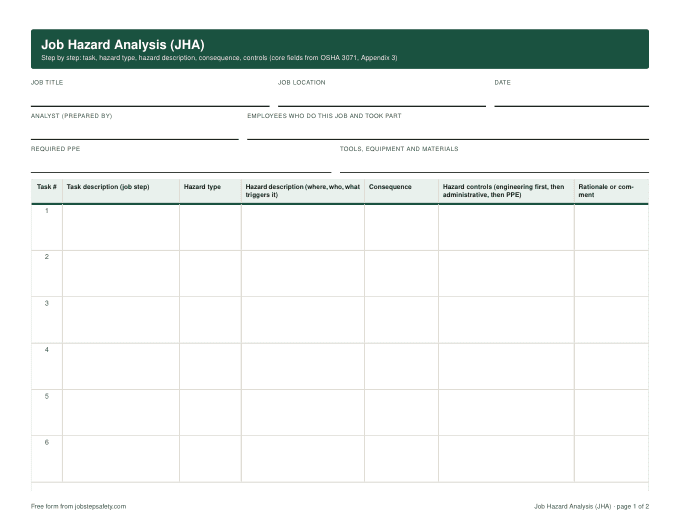
Need the one-page version to fill in by hand on site? That is the JHA field form, which has hazard-type checkboxes instead of a wide table.
What is on the form
OSHA describes the method the form supports like this:
“A job hazard analysis is a technique that focuses on job tasks as a way to identify hazards before they occur. It focuses on the relationship between the worker, the task, the tools, and the work environment.”
| On the form | What goes there |
|---|---|
| Job title, location, date, analyst | The header fields on OSHA's sample form. [OSHA] "Analyst" is whoever leads the analysis; add the employees who took part on the next line. |
| Required PPE; tools and materials | Two lines we added so the PPE the controls call for is listed once at the top, and the tools and materials involved are named. |
| Task # and task description | One row per step of the job, in the order the worker does them. OSHA says to watch the job being done and list each step as the worker takes it. [OSHA] |
| Hazard type | A short category such as "Fall (slip, trip)" or "Struck by". OSHA 3071 Appendix 2 lists the common types. [OSHA] |
| Hazard description | Where it happens, who is exposed and what triggers it. OSHA says a good hazard description covers the environment, the exposure, the trigger and the consequence. [OSHA] |
| Consequence | What the injury or damage would be if the hazard is not controlled. |
| Hazard controls | What removes or reduces the hazard. OSHA ranks engineering controls first, then administrative controls, then PPE. [OSHA] |
| Rationale or comment | The last column on OSHA's sample form. [OSHA] Use it for why a control was chosen, or what still needs a decision. |
| Reviewed with crew, next review | Who walked the finished analysis through with the people who do the job, and when it is due for review. |
How to fill it in
- Bring in the people who do the job. OSHA puts this first: they know the job, and they will own the fixes. [OSHA] Look at the accident and near-miss history for the job with them before you start writing. [OSHA]
- List the steps. Watch the job being done and write each step as the worker takes it, then check the list with them. [OSHA] OSHA's advice on how fine to cut the steps:
“Avoid making the breakdown of steps so detailed that it becomes unnecessarily long or so broad that it does not include basic steps.”
- Take each step and ask what could go wrong. OSHA's five questions: what can go wrong, what are the consequences, how could it arise, what else contributes, and how likely is it. [OSHA]Write the answers in the hazard description and consequence columns.
- Pick controls in order. Engineering controls that change the machine or the workplace come first, then administrative controls such as procedures and training, then PPE. [OSHA]Write them in the controls column and note the reason in the comment column.
- Fix the urgent things now. OSHA says anything that poses an immediate danger gets immediate action, and anything easy to fix gets fixed, without waiting for the analysis to be finished. [OSHA]
- Review it with the crew and sign. Discuss the recommended controls with everyone who does the job and consider their responses. [OSHA] Then fill in the review line.
Example row, from OSHA's own JHA
OSHA 3071 works through grinding iron castings in a metal shop. Here is its first step, as it would sit in one row of this template. The task description, hazard description and controls are OSHA's words; the hazard type is our pick from OSHA's Appendix 2 list.
- Metal Shop
“Worker reaches into metal box to the right of the machine, grasps a 15-pound casting and carries it to grinding wheel. Worker grinds 20 to 30 castings per hour.”
- Struck by (falling object)
“Picking up a casting, the employee could drop it onto his foot. The casting's weight and height could seriously injure the worker's foot or toes.”
- Serious foot or toe injury (taken from the hazard description above).
“1. Remove castings from the box and place them on a table next to the grinder. 2. Wear steel-toe shoes with arch protection. 3. Change protective gloves that allow a better grip. 4. Use a device to pick up castings.”
Notice the order of the controls: moving the castings to a table changes the workplace (engineering), and the footwear and gloves are PPE. OSHA's example for the same step goes on to cover the sharp burrs on the castings and the lifting strain, each as its own hazard with its own controls. [OSHA]One step can fill several rows.
When to review it
OSHA's advice is to look at each analysis again from time to time so it stays current; even when a job has not changed, a fresh look can turn up hazards missed the first time. [OSHA] Two triggers get a review straight away:
“It is particularly important to review your job hazard analysis if an illness or injury occurs on a specific job.”
The second is a close call caused by someone not following the written steps: discuss it with everyone who does the job. [OSHA] And whenever you change the analysis, train everyone the change affects in the new steps or protective measures. [OSHA] The "next review" box on the form is for the date or the trigger you choose.