 JobStep Safetyjobstepsafety.com
Read this to your crew
1. Why we spend time on this
Falls kill more people in construction than anything else. OSHA puts it plainly:
“Historically, falls are the leading cause of fatalities in construction, accounting for about one-third of all fatalities in the industry.”
The risky moments on a site are usually ordinary ones: a roof edge on a short job, a skylight someone walks backward into, a deck where the guardrail came down to land a load and never went back up. That is what today is about.
2. The number is six feet
On a construction job, once you are working 6 feet or more above a lower level, you need fall protection. That means one of three things: a guardrail, a safety net, or a personal fall arrest system, which is the harness, the lanyard or lifeline, and the anchor. [OSHA] The 6 feet is measured to wherever you would land, so a deck over an open basement counts from the basement floor, not from the ground outside. [OSHA]
Height is not the only trigger. If you could fall into or onto dangerous equipment, such as open gears, belts or a tank of chemicals, you are protected at any height. [OSHA]
3. A rail beats a harness
A guardrail stops you from going over. A harness only stops you after you have gone over. OSHA encourages employers to pick systems that prevent the fall in the first place, such as guardrails at the edge of a building. [OSHA] So when a rail can go up, it goes up. A rail that gets taken down for a delivery goes back up before anyone walks away from that edge.
4. Look down as well as out
A hole is any gap of 2 inches or more in a floor, roof or other surface you walk on. [OSHA] Skylights count. Covers on holes have to be strong enough for what crosses them, fastened so they cannot slide, and marked so nobody picks one up to use as a board. [OSHA] If you lift a cover, it goes back and gets fastened before you leave it.
5. Plan the rescue first
A harness that catches you has only done half the job. The employer has to provide for prompt rescue, or make sure workers can rescue themselves. [OSHA] Before anyone ties off today, we know who gets them down and with what, whether that is a lift, a ladder, a rescue kit or the fire department.
Which protection for which job
Subpart M sets out what is accepted for each kind of work. These are the ones that come up most on general construction sites, as OSHA summarises them in its fall protection booklet: [OSHA]
| Where you are working | What OSHA accepts | Rule |
|---|---|---|
| Any edge or open side 6 feet or more above a lower level | Guardrail, safety net or personal fall arrest | 1926.501(b)(1) |
| Building a leading edge, such as decking or formwork as it goes out | Guardrail, safety net or personal fall arrest. A written fall protection plan only where the employer can show those are infeasible or a greater hazard | 1926.501(b)(2) |
| Hoist area, including leaning out to land material | Guardrail or personal fall arrest. Once the guardrail is opened for hoisting, a personal fall arrest system | 1926.501(b)(3) |
| Ramp, runway or walkway 6 feet or more up | Guardrails on each open side | 1926.501(b)(6) |
| Low-slope roof (4 in 12 or flatter) | Guardrail, net or personal fall arrest; or a warning line used together with one of those, or with a safety monitor. A safety monitor with no warning line is allowed only where the roof is no wider than 50 feet | 1926.501(b)(10) |
| Steep roof (pitch over 4 in 12) | Guardrail with toeboards, safety net or personal fall arrest | 1926.501(b)(11) |
| Wall opening with the outside bottom edge 6 feet or more up and the inside bottom edge under 39 inches | Guardrail, safety net or personal fall arrest | 1926.501(b)(14) |
| Edge of a well, pit or shaft 6 feet or more deep | Guardrails, fences, barricades or covers | 1926.501(b)(7) |
On leading edge, precast concrete and residential work where none of those systems can be used, the written plan has to cover set elements. The free fall protection plan builder lays them out for your site and prints the plan. [OSHA]
The numbers behind each system: a guardrail's top rail sits at 42 inches, plus or minus 3, and holds at least 200 pounds pushed outward or downward at the top edge. [OSHA] A safety net hangs no more than 30 feet below the work. [OSHA] A personal fall arrest system is rigged so you cannot free fall more than 6 feet or hit the level below, and it stops you within 3.5 feet once it starts to slow you down. [OSHA] An anchor holds 5,000 pounds for each person tied to it, unless a qualified person has designed the system keeping a safety factor of two or more. [OSHA]
That last pair of numbers is why a 6 foot lanyard tied off at your feet on a low deck can still let you hit the floor. Look at what is under you, not just at the lanyard.
Check your harness first
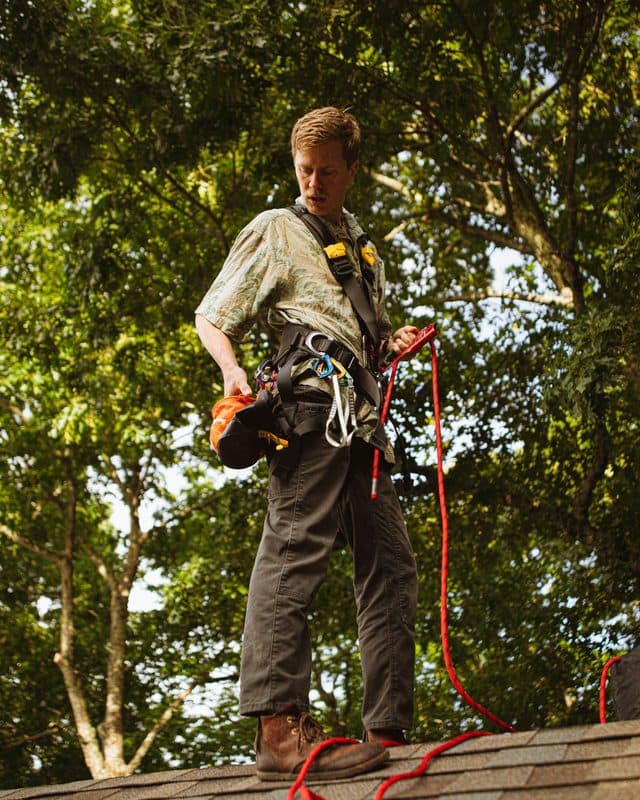
Read the list, then have each person check their own harness and lanyard with a partner watching. OSHA's rule is that the whole system is inspected before each use and anything defective is taken out of service. [OSHA]
| Check | Why |
|---|---|
| Webbing and stitching: run every strap and seam through your hands looking for cuts, fraying, burns and pulled or broken stitches. | The whole system is inspected before each use for wear, damage and other deterioration, and anything defective comes out of service. [OSHA] |
| D-rings and buckles: no cracks, bends, sharp edges or rough spots. | Connectors need smooth surfaces and edges, and D-rings and snaphooks have a minimum strength of 5,000 pounds. [OSHA] |
| Snaphooks: the gate locks on its own and stays locked when you push on it. | Only locking snaphooks are allowed in a personal fall arrest system. [OSHA] |
| Has this harness or lanyard ever stopped a fall? A shock absorber that has opened up means yes. | Gear that has taken a fall is out of service until a competent person inspects it and clears it. [OSHA] |
| Once it is on: the back D-ring sits between your shoulder blades, not down at your waist. | The harness attachment point belongs in the center of the back near shoulder level, or above the head. [OSHA] |
| The anchor: you know what you are tying off to, and it is not a guardrail or a hoist. | Personal fall arrest systems may not be attached to guardrail systems or hoists. [OSHA] |
“Personal fall arrest systems and components subjected to impact loading shall be immediately removed from service and shall not be used again for employee protection until inspected and determined by a competent person to be undamaged and suitable for reuse.”
Holes and covers
Holes are the fall nobody plans for, because they are in the middle of the floor instead of at the edge. Each worker has to be protected from tripping in or stepping into or through holes, skylights included, by covers. [OSHA] Where the drop is more than 6 feet, the hole needs a cover, a guardrail around it, or personal fall arrest. [OSHA] The cover rules are short:
- Strong enough for at least twice the weight of the people, equipment and materials that could be on it at once. In a roadway, twice the heaviest axle load expected to cross. [OSHA]
- Secured so wind, equipment or people cannot knock it out of place. [OSHA]
- Color coded, or marked with the word HOLE or COVER. [OSHA]
A sheet of plywood laid loose over a hole meets none of those until it is fastened and marked. And a cover is not storage: stacking material on one is how it gets overloaded or slid aside.
If someone falls
Call for help and start the rescue plan agreed before the work began. Every minute counts.
“The employer shall provide for prompt rescue of employees in the event of a fall or shall assure that employees are able to rescue themselves.”
A person hanging in a harness cannot wait for someone to go looking for a ladder that reaches. That is why the plan names the equipment and the people before work at height begins. Nobody climbs out to reach a fallen worker without their own fall protection, because the 6 foot rule applies to the rescuer too. [OSHA] Once the person is down, the harness and lanyard that caught them are tagged out of service until a competent person inspects them. [OSHA]
Questions for the crew
- Where on today's job could someone fall 6 feet or more, and what is protecting each of those spots?
- Which holes or openings are covered right now, and who checks that the covers are still fastened at the end of the day?
- Show your harness to the person next to you. Webbing, stitching, hardware, hooks: does it pass?
- If someone is left hanging in a harness this afternoon, who gets them down, and with what?
A sign-in sheet prints after this talk. For a blank copy to use at other meetings, the free sign-in sheet template comes as a PDF or Word file.
What the law says
Construction fall protection is 29 CFR 1926 Subpart M: the scope and definitions in 1926.500, where protection is required in 1926.501, how each system is built and used in 1926.502, and training in 1926.503. [OSHA] The core rule:
“Each employee on a walking/working surface (horizontal and vertical surface) with an unprotected side or edge which is 6 feet (1.8 m) or more above a lower level shall be protected from falling by the use of guardrail systems, safety net systems, or personal fall arrest systems.”
Every worker who might be exposed to fall hazards gets training from a competent person, covering the hazards in their work area and how to put up, use, inspect and take down the systems they will use. [OSHA] The employer keeps a written certification record of that training with each worker's name, the date and the trainer's or employer's signature, and retrains when the workplace or the equipment changes. [OSHA]
Scaffolds, ladders, aerial lifts, steel erection and cranes have their own fall rules in other subparts, so a scaffold job is checked against the scaffold standard, not only Subpart M. [OSHA] When a roof or deck job needs its own written steps, put the steps, hazards and controls on a printable JHA template. If you would rather hand it off, a Custom JHA writes one for your crew's actual task, such as a reroof or setting trusses, with the OSHA rules that apply.
More fall talks
Falls are too big for one meeting. These go further on single topics:
- Fall protection: six feet, every time: the short version, for a quick morning huddle.
- December safety topics: snow and ice on roofs and decks, with its own weekly talks.
- 100 safety topics for daily toolbox talks: the free PDF, with the falls topics grouped together.
The 52-Week Toolbox Talk Planner gives falls a full five weeks in the spring: when fall protection is required in week 14, inspecting your harness and lanyard in week 15, guardrails, holes and covers in week 16, scaffolds in week 17 and aerial lifts in week 18, plus ladders in week 4.