 JobStep Safetyjobstepsafety.com
Planning ahead? The February 2027 safety topics are ready too: silica dust in closed-in buildings, first aid on site, back strain on cold and slippery days, and cords and GFCIs in the thaw.
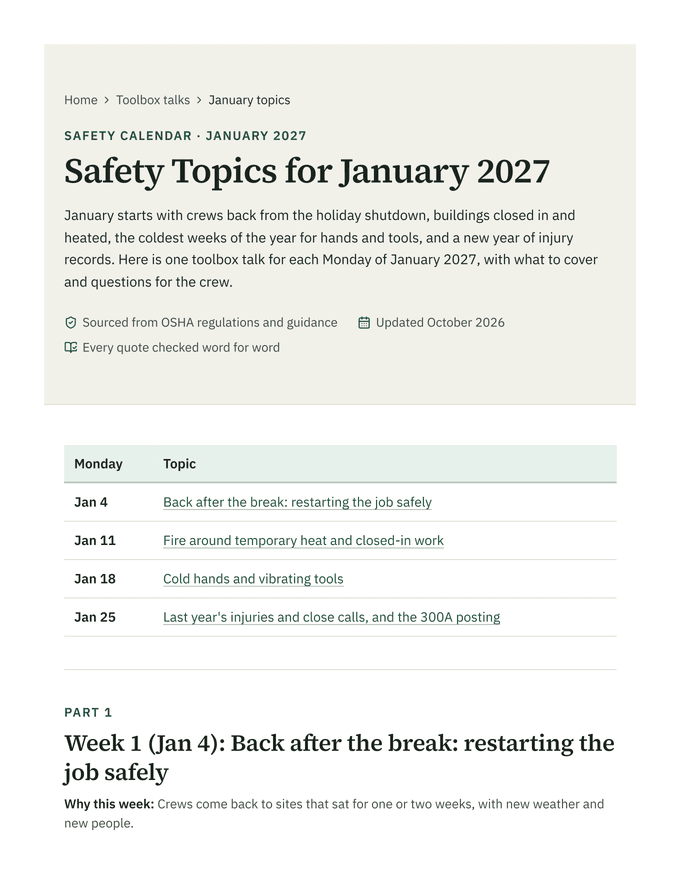
Week 1 (Jan 4): Back after the break: restarting the job safely
Why this week: Crews come back to sites that sat for one or two weeks, with new weather and new people.
A site that sat for a week or two is not the site you left. Snow loads, frozen ground, wind and other trades may have changed it. OSHA's job hazard analysis guide makes the point:
“New circumstances and a recombination of existing circumstances may cause old hazards to reappear and new hazards to appear.”
Walk the site before the first task:
- Guardrails, covers and barricades: are they all still in place, and did anything blow down or get moved?
- Scaffolds, ladders and anything that held snow or ice while the site was empty: check them before anyone climbs.
- Equipment that sat in the cold: batteries, hydraulic leaks, fuel and the walk-around inspection.
- Excavations and footings: frost, water and any wall that moved while nobody was watching.
Then check the plan. If the work, the weather or the crew changed over the break, review the job hazard analysis for that task before you restart it. OSHA calls periodic review what keeps a JHA current. [OSHA]
Ease people back in. Among OSHA's winter work practices:
“Acclimatizing new workers and those returning after time away from work by gradually increasing their workload, and allowing more frequent breaks in warm areas, as they build up a tolerance for working in the cold environment”
New hires who start in January need a full orientation before their first task. The free safety orientation checklist covers it in one page.
Ask the crew:
- What looks different on this site from when we left it?
- Who is new, or back after a long break, and who is pairing up with them this week?
Week 2 (Jan 11): Fire around temporary heat and closed-in work
Why this week: Buildings are closed in and heated, with fuel and combustibles close together.
January means closed-in buildings, temporary heat, fuel cans and wrapped materials close together. The heater itself and carbon monoxide were the November talk. This week is about fire.
Clearances. The construction heater rule:
“Temporary heating devices shall be installed to provide clearance to combustible material not less than the amount shown in Table F-4.”
Read the clearances for your heater type off that table and the heater's label, and keep tarps, lumber, insulation and trash outside them. Solid fuel salamanders are not allowed in buildings or on scaffolds at all. [OSHA]
Extinguishers: how many and how close. Two numbers from the construction fire rule:
“A fire extinguisher, rated not less than 2A, shall be provided for each 3,000 square feet of the protected building area, or major fraction thereof. Travel distance from any point of the protected area to the nearest fire extinguisher shall not exceed 100 feet.”
“A fire extinguisher, rated not less than 10B, shall be provided within 50 feet of wherever more than 5 gallons of flammable or combustible liquids or 5 pounds of flammable gas are being used on the jobsite.”
Using one. OSHA's steps for a small fire: sound the alarm, pick your way out before you approach, and never let the fire get between you and that exit. Then the P.A.S.S. technique: pull, aim, squeeze, sweep. [OSHA] Aim at the base of the fire, not the flames, and back away once it is out in case it flares up. [OSHA] If the extinguisher runs empty, or the fire grows, get out. [OSHA] The 5-minute fire talk covers fuel storage and smoking.
Ask the crew:
- Point to the nearest extinguisher from where you work today. How far is it?
- What is stored within the heater clearance right now, and who moves it?
Week 3 (Jan 18): Cold hands and vibrating tools
Why this week: The coldest weeks of the year, when vibration white finger symptoms show up.
Grinders, hammer drills, breakers, chipping guns and chainsaws all shake the hands that hold them. Over time that can damage the blood vessels and nerves in the fingers. NIOSH calls it vibration syndrome:
“The signs and symptoms include numbness, pain, and blanching (turning pale and ashen).”
Cold is what brings it out. In NIOSH's words:
“The symptoms usually appear suddenly, and are precipitated by exposure to cold.”
What to do on the job, from NIOSH:
- Keep hands warm and dry while working. [NIOSH (CDC)]
- If your hands get wet and chilled, dry them and put on dry, warm gloves before you pick the tool up again. Bring a spare pair. [NIOSH (CDC)]
- Gloves keep hands warm, which helps, but they are not a way to cut the vibration itself. [NIOSH (CDC)]
- Tingling or numbness for a short while during or right after using the tool is not the syndrome. Fingers that go white, or tingling and numbness that last, are a reason to see a doctor promptly. [NIOSH (CDC)]
Cold stress itself, the four cold injuries and first aid, is in the full cold weather talk.
Ask the crew:
- Who runs a vibrating tool for more than an hour on a normal day?
- Has anyone had fingers go white or stay numb in the cold? Who would you tell?
Week 4 (Jan 25): Last year's injuries and close calls, and the 300A posting
Why this week: The OSHA 300A summary goes up by February 1. Use it to plan the year.
The start of the year is the time to look back. If your company keeps OSHA injury records, the annual summary of last year's log goes up this week or next:
“You must post the summary no later than February 1 of the year following the year covered by the records and keep the posting in place until April 30.”
Before it is posted, the log is reviewed and corrected, the summary is made, and a company executive certifies it. [OSHA] It goes where notices to employees are usually posted, and nobody covers it up. [OSHA] Small companies are often exempt from keeping the records:
“If your company had 10 or fewer employees at all times during the last calendar year, you do not need to keep OSHA injury and illness records unless OSHA or the Bureau of Labor Statistics informs you in writing that you must keep records”
Even then, every employer covered by the OSH Act must report a work-related fatality, an in-patient hospitalization, an amputation or the loss of an eye. [OSHA]
Turn it into a talk. Records are only useful if the crew hears what they say:
- Read out last year's count, without names: injuries, close calls, and the tasks they happened on.
- Name the one or two tasks that keep showing up, and what changes this year.
- Remind everyone how to report an injury or a near miss, and that nobody is punished for reporting.
For writing up close calls, see the free incident report form.
Ask the crew:
- What was the closest call you saw last year that never got written down?
- If you got hurt today, who would you tell, and how?