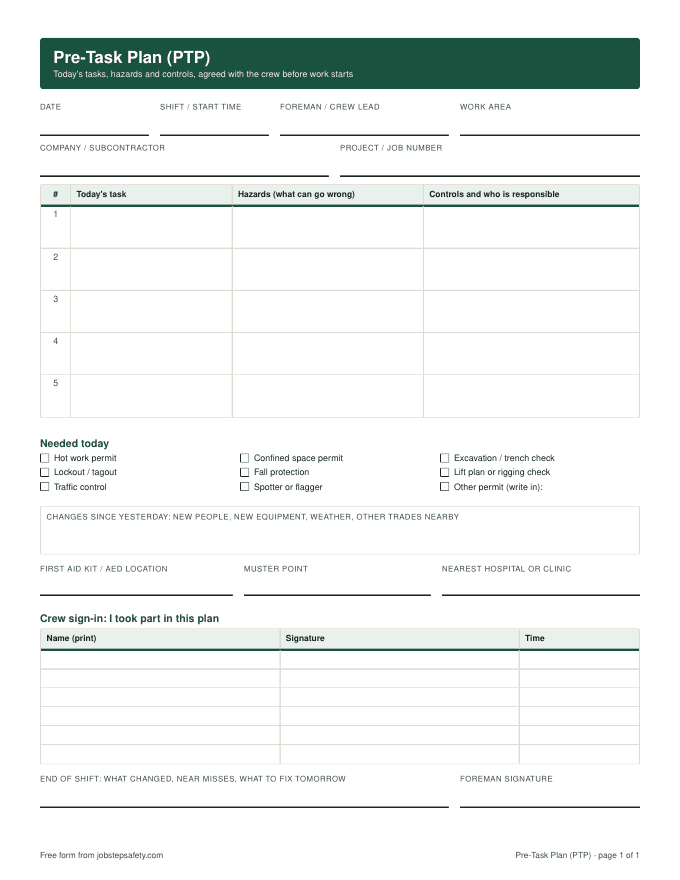
What is on the form
| On the form | What goes there |
|---|---|
| Date, shift, foreman, work area | One plan per crew per day. The work area is the part of the site this crew is in today, so other trades can see who is where. |
| Company and project number | For the subcontractor file and for the general contractor who collects the plans each morning. |
| Today's tasks (5 rows) | Task, hazards, controls and who is responsible. The same three questions as a JHA, asked about today only. OSHA's starting point for any hazard is what can go wrong, what the consequences are and how it could arise. [OSHA] |
| Needed today (9 boxes) | Hot work permit, confined space permit, excavation or trench check, lockout/tagout, fall protection, lift plan or rigging check, traffic control, spotter or flagger, other. A ticked box means someone has to produce that thing before the task starts. |
| Changes since yesterday | New people, new equipment, weather, other trades nearby. OSHA notes that new circumstances, and old ones in a new combination, bring back old hazards and create new ones. [OSHA] This box is where you catch them. |
| First aid, muster point, nearest hospital | Three lines, filled in every day, so a new hire learns them on day one and everyone can say them without looking. |
| Crew sign-in (6 lines) | Name, signature, time. Signing means the person heard the plan and can say what the hazards are. |
| End of shift | What changed, near misses, what to fix tomorrow. Filling this in takes two minutes and feeds the next morning's "changes since yesterday" box. |
The ten-minute routine
- Walk to the work area with the crew. Fill in the header on the way.
- Name today's tasks. Up to five. If the day has more, the crew is doing more than one plan's worth of work and the foreman should split it.
- For each task, ask what can go wrong and to whom. Let the crew answer. OSHA's reason for involving the people who do the job: they have a unique understanding of it, and that knowledge is what finds the hazards. [OSHA]
- Write the control and a name. Prefer a change to the setup over a reminder to be careful; OSHA ranks engineering controls first, then procedures, then PPE. [OSHA]
- Tick the "needed today" boxes and decide who gets each permit or piece of equipment before work starts.
- Fill the "changes since yesterday" box. New hire, rented lift, rain overnight, another trade overhead. This is the box that earns the form its place.
- Say the emergency lines out loud, then everyone signs.
- At the end of the shift write what changed and any near miss. Tomorrow's plan starts from it.
Where the pre-task plan fits with the JHA
A job hazard analysis is written once per job and kept. OSHA says to review it periodically, and particularly after an injury or illness linked to that job. [OSHA] It also explains why a written analysis alone is not enough on a changing site:
“New circumstances and a recombination of existing circumstances may cause old hazards to reappear and new hazards to appear.”
The pre-task plan is the daily check for exactly that. The JHA for the task gives the steps and the standing controls; the plan records what is different today and who is doing what. On construction work it also serves the instruction duty in 29 CFR 1926.21, which asks employers to teach every employee how to recognize and avoid the unsafe conditions of their work, and the rules that apply to it. [OSHA]A signed plan with the hazards written on it is a record of that instruction for that day.