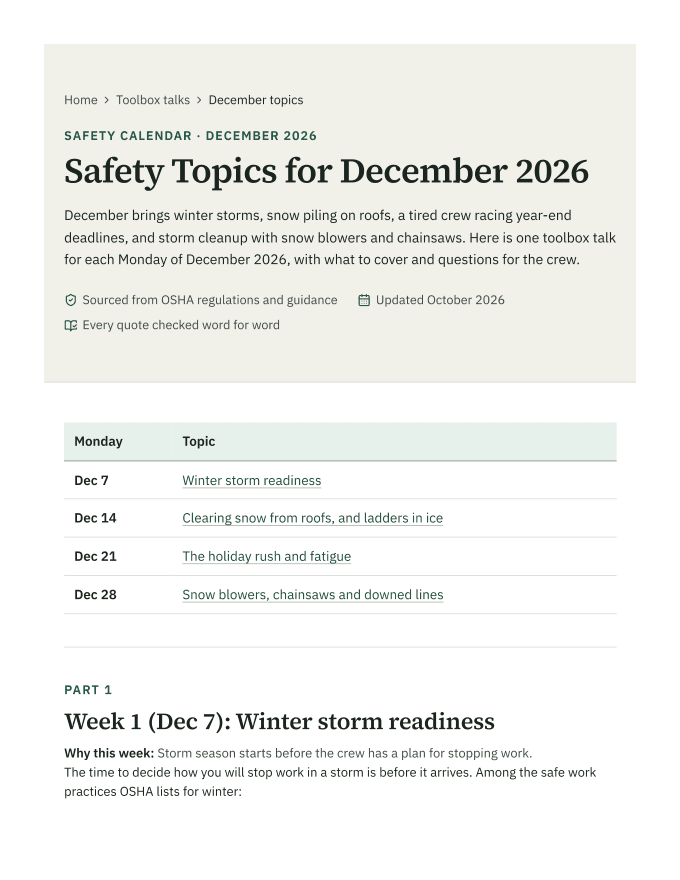
| Monday | Topic |
|---|---|
| Dec 7 | Winter storm readiness |
| Dec 14 | Clearing snow from roofs, and ladders in ice |
| Dec 21 | The holiday rush and fatigue |
| Dec 28 | Snow blowers, chainsaws and downed lines |
Week 1 (Dec 7): Winter storm readiness
Why this week: Storm season starts before the crew has a plan for stopping work.
The time to decide how you will stop work in a storm is before it arrives. Among the safe work practices OSHA lists for winter:
“Monitoring the weather conditions during a winter storm, having a reliable means of communicating with workers and being able to stop work or evacuate when necessary”
Turn that into four answers the crew can repeat back:
- Who watches the forecast and the NOAA watches, advisories and warnings for this site. [OSHA]
- How we reach everyone, including anyone working alone or somewhere remote. [OSHA]
- Who can stop the work, and where we go when we do. [OSHA]
- What the work plan says about the hazards of the job and the protections we will use. OSHA lists work plans that identify both as a safe work practice. [OSHA]
Also plan for new people and anyone back from time off. OSHA suggests building up their workload gradually, with more frequent breaks in warm areas, while they get used to the cold. [OSHA]
Ask the crew:
- If a storm warning comes in at 10 a.m., who decides whether we keep working, and how will you hear?
- Who on this crew works alone or out of sight, and how do we check on them?
Week 2 (Dec 14): Clearing snow from roofs, and ladders in ice
Why this week: The first heavy snow lands on roofs, decks and scaffolds.
OSHA's hazard alert on rooftop snow removal is blunt about what kills people:
“Based on the findings of OSHA investigations, falls cause the most worker fatalities and injuries during rooftop snow removal. Workers may fall off roof edges, through skylights, and from ladders and aerial lifts. Workers may also be injured or killed by a roof collapse.”
Before anyone goes up:
- Ask first whether the snow can come off without anyone on the roof: snow rakes or drag lines from the ground, or de-icing applied from a ladder. [OSHA]
- Mark skylights, roof drains and vents before snow hides them. [OSHA]
- Confirm the roof can carry the snow plus the workers and their equipment. Clear snow evenly across the roof and do not pile it up, so the load stays balanced. [OSHA]
- Use fall protection where edges are not guarded, put harnesses on before climbing up, and have a plan to rescue someone caught by their fall arrest system. [OSHA]
- Keep people on the ground back from where snow will fall. OSHA's example is 10 feet from the point where snow is expected to land. [OSHA]
Ladders in ice. OSHA's ladder points for snow work:
- Never use a snow rake or shovel from a ladder. [OSHA]
- Check rungs for ice and clean the snow off your boots before you climb. [OSHA]
- Level, secure footing; base out one quarter of the ladder's working length; extend it 3 feet above the roof edge or secure it with rail extensions. [OSHA]
- Three points of contact, body inside the rails, and nothing heavy carried up the ladder: haul it with a rope instead. [OSHA]
Ask the crew:
- Which roofs or decks on our jobs will need clearing, and can we do any of it from the ground?
- Where are the skylights and openings on those roofs right now, before the snow?
Week 3 (Dec 21): The holiday rush and fatigue
Why this week: Year-end deadlines meet holiday plans, and people work long, tired days.
The last weeks of the year push long days, extra shifts and short sleep. In OSHA's words:
“Long work hours may increase the risk of injuries and accidents and can contribute to poor health and worker fatigue.”
What OSHA suggests employers do:
- Look at workload, hours, understaffing and absences that are driving the overtime. [OSHA]
- Schedule so people get regular rest breaks and a proper night's sleep. [OSHA]
- Use lighting and temperature to help people stay alert. [OSHA]
What workers can do, from OSHA's sleep advice:
“Make sure that your sleep period is 7-9 hours daily without disruptions.”
“If working evening or nights, make sure that sleep has occurred within the last 8 hours before going to work.”
Ask the crew:
- Who has worked more than a normal week for the last two weeks?
- Which task on this job is the worst one to do tired, and when are we scheduling it?
Week 4 (Dec 28): Snow blowers, chainsaws and downed lines
Why this week: Storm cleanup: powered equipment, fallen trees and damaged power lines.
Snow blowers. OSHA says they commonly cause lacerations and amputations when operators clear jams with the machine on. [OSHA]
“Never attempt to clear a jam by hand. First, turn the snow blower off and wait for all moving parts to stop, and then use a long stick to clear wet snow or debris from the machine.”
Refuel before starting, never while it runs or the engine is hot. [OSHA]
Downed lines. Treat every one as live:
“Assume all power lines are energized and stay clear of any downed or damaged power lines.”
Only trained electrical utility workers handle damaged lines. Watch for tree limbs touching a downed line: they can carry the current too. [OSHA]
Chainsaws and chippers on downed trees. OSHA lists the PPE: gloves, chaps, foot protection, eye protection, fall protection, hearing protection and head protection. Use only equipment designed for outdoor, wet conditions, inspect it before use, and never bypass a guard. [OSHA]
Ask the crew:
- Who here runs a snow blower or saw for storm cleanup, and what do you do when it jams?
- If you find a line down on the way to site, who do you call and how far back do you stay?