 JobStep Safetyjobstepsafety.com
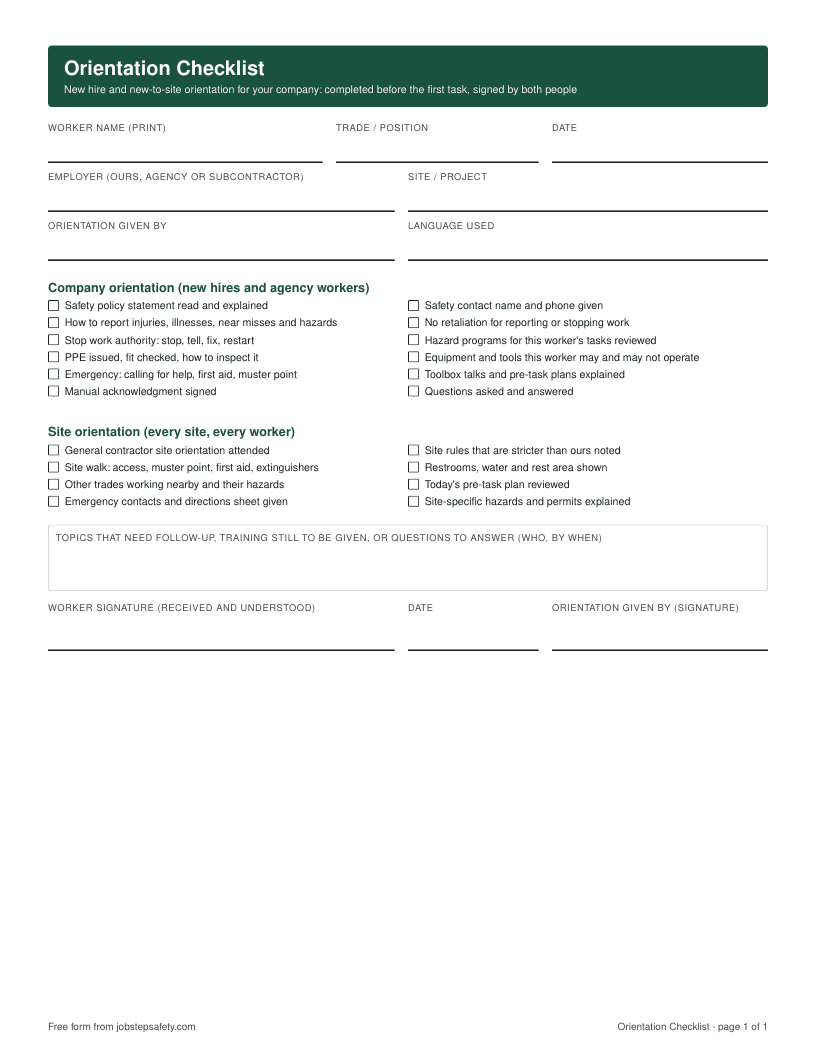
What is on the checklist
- Worker details: name, trade, employer, site, who gave the orientation and in what language.
- 12 company items for new hires and agency workers: policy, reporting, stop work, PPE, emergencies.
- 8 site items for every worker on a new job: GC rules, site walk, nearby trades, permits.
- Follow-up box for training still to give, with who and by when.
- Signatures from the worker and the person who gave it.
What a safety orientation is, and why it comes first
A safety orientation is what a worker hears before their first task: how your company works safely, the hazards of their job, and what to do if something goes wrong. It happens twice. Once when someone is hired, covering your company program, and again every time a worker arrives on a new site, covering the site.
New workers are the ones who do not know which hazards are normal on your jobs. The checklist makes sure nothing is skipped on a busy morning, and the signatures show it happened.
What OSHA requires before someone starts work
OSHA's construction rules do not name a form, but they do require the training an orientation delivers:
“The employer shall instruct each employee in the recognition and avoidance of unsafe conditions and the regulations applicable to his work environment to control or eliminate any hazards or other exposure to illness or injury.”
Some standards also set the timing. Hazard communication training happens when a worker starts the job:
“Employers shall provide employees with effective information and training on hazardous chemicals in their work area at the time of their initial assignment, and whenever a new chemical hazard the employees have not previously been trained about is introduced into their work area.”
And workers who might be exposed to fall hazards need a fall protection training program, recorded on a written certification record. [OSHA] Orientation is the place to check those boxes, or to book the training before the worker goes up.
Company orientation: 12 items for every new hire
- Safety policy. Read it together. Explain what it means on a real day.
- Safety contact. Give the name and phone number of the person who runs the program.
- Reporting. How to report injuries, illnesses, near misses and hazards, and to whom. Every worker must be told the procedure for reporting work-related injuries and illnesses. [OSHA] Show them the incident report form the supervisor fills in.
- No retaliation. Workers have the right to report injuries and illnesses, and the employer may not punish them for it. [OSHA]
- Stop work authority. Anyone can stop work they believe is unsafe. See our stop work authority guide.
- Hazard programs for their tasks. Go over the programs that apply to this worker's work: falls, ladders, silica, chemicals and so on.
- PPE. Issue it, check the fit, and show how to inspect it before each use.
- Equipment. Which tools and machines this worker may operate. Only workers qualified by training or experience may operate equipment and machinery. [OSHA]
- Emergencies. How to call for help, where first aid is, and the muster point.
- Toolbox talks and pre-task plans. When they happen, and that everyone takes part.
- Manual acknowledgment. The worker signs that they received and understood the safety manual.
- Questions. Ask what they have done before and what they are unsure about. Write down follow-up training.
Site orientation: 8 items on every new job
- The general contractor's own site orientation, if there is one.
- Site rules that are stricter than yours.
- A site walk: access routes, the muster point, first aid and fire extinguishers.
- Restrooms, drinking water and the rest area.
- Other trades working nearby, and the hazards their work creates for yours. OSHA's construction guide expects contractors on a site to share those hazards with each other. [OSHA]
- Today's pre-task plan.
- The emergency contacts and directions sheet for this site. The free emergency action plan template covers who to call, the exit routes and the assembly point.
- Site-specific hazards and any permits: confined spaces, hot work, energized equipment.
How to run the orientation
- Before the first task, not after. A worker who starts before orientation is learning your hazards the hard way.
- Walk and talk. Do the site items on the site, not in the truck. Point at the muster point and the extinguisher.
- Use their language. Give the orientation in the language the worker understands best, and write it on the form.
- Pair them up. Put a new worker with an experienced one for the first days.
- File the form. Both people sign. Keep it with the worker's training records.
Questions
Common questions
What is a basic safety orientation?
The safety briefing a worker gets before their first task: how the company works safely, how to report injuries and hazards, how to stop unsafe work, the hazards of their job and the PPE they need, and what to do in an emergency. On a new site it adds the site itself: access, the muster point, first aid and the general contractor's rules.
How long should a safety orientation take?
OSHA does not set a length. Cover every item on the checklist and the specific training the worker's tasks need; for a typical new hire that is part of the first morning, with task training before each new kind of work.
Do temporary and staffing agency workers need orientation?
Yes. They face the same hazards as everyone else on the site. OSHA's construction program guide expects general contractors, contractors and staffing agencies to give all workers the same level of protection and to share the hazards of the site with each other.
Who should give the orientation?
Someone who knows the company program and the site: the safety contact, the foreman or a crew lead. Pair the new worker with an experienced one for the first days.
Do I need to keep a record?
Keep the signed checklist in the worker's file. Some standards require a written training record, such as the certification record for fall protection training, and a signed checklist shows the orientation happened if a general contractor or inspector asks.
Sources
More safety program help
Also useful