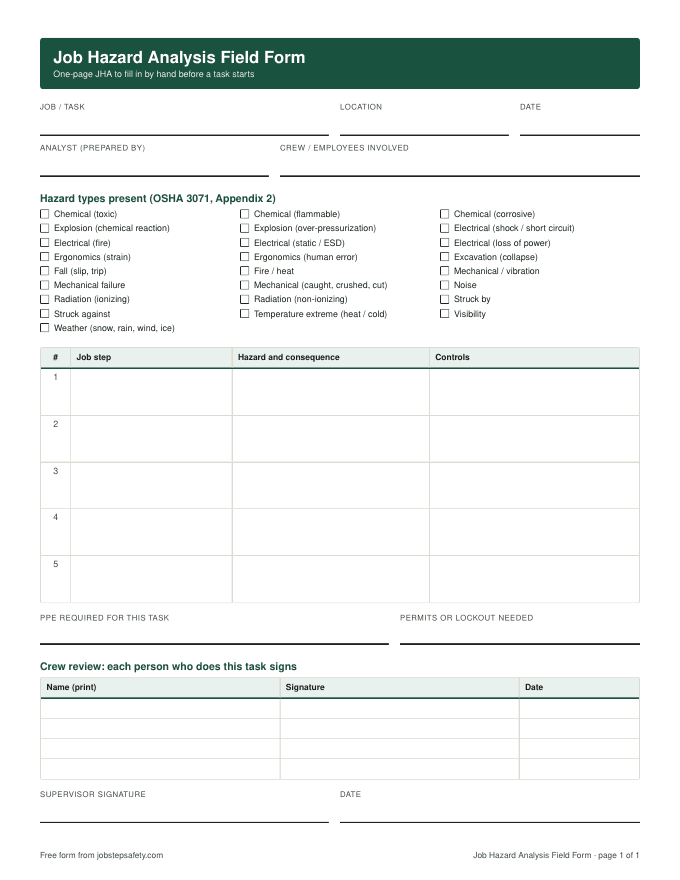
For a full job with many steps, typed up and kept on file, use the JHA templateinstead. It is a wide table with ten rows and a comment column.
What is on the form
| On the form | What goes there |
|---|---|
| Job / task, location, date | Name the task the way the crew says it, and the exact place: "pull cable, mechanical room B2", not "electrical work". |
| Analyst and crew | Who led the analysis and who took part. OSHA says involving the employees who do the job is the first step, because they know it best. [OSHA] |
| Hazard types present (25 boxes) | The hazard families from OSHA 3071 Appendix 2: chemical, explosion, electrical, ergonomics, excavation, fall, fire and heat, mechanical, noise, radiation, struck by, struck against, temperature extremes, visibility and weather. [OSHA] Tick every one that applies before you write the steps; the boxes are a prompt. |
| Five step rows | Job step, hazard and consequence, controls. Five rows fit a single task of the kind a crew plans at the start of a shift. A longer job belongs on the multi-page template. |
| PPE required; permits or lockout | The PPE the controls call for, listed once, and any permit or lockout the task needs before it can start. |
| Crew review signatures | Four lines for the people who do the task, plus the supervisor. OSHA says to discuss the recommended controls with everyone who performs the job and to consider their responses. |
How to fill it in on site
- Fill in the header with the crew present, then go down the hazard-type boxes together. Ticking "fall" or "struck by" before you write a single step makes the step rows easier.
- Write the steps in the order the work happens. OSHA's rule of thumb is to record enough to describe each action without going into too much detail. [OSHA]
- For each step, write the hazard so someone who was not there understands it. OSHA says a good hazard description covers where it happens, who or what is exposed, what triggers it, and what the outcome would be. [OSHA]
- Write controls in the order OSHA ranks them: a physical change first, then a procedure or a rule, then PPE. [OSHA] If the only control you can find is PPE, say so in the row; it is a flag for the office to look at the job again.
- If a hazard is an immediate danger, stop and deal with it now rather than finishing the form. [OSHA]
- Everyone who does the task signs. The supervisor signs last and keeps the sheet.
Example: how OSHA writes a hazard
The "hazard and consequence" column is the one people struggle with. OSHA 3071 gives a one-sentence model that names the place, the trigger, the exposure and the result:
“In the metal shop (environment), while clearing a snag (trigger), a worker's hand (exposure) comes into contact with a rotating pulley. It pulls his hand into the machine and severs his fingers (consequences) quickly.”
On this form that row would read: step "clear snag from pulley"; hazard and consequence "hand contacts rotating pulley, pulled in, fingers severed"; and the hazard-type boxes ticked would be "Mechanical (caught, crushed, cut)". OSHA's own comment on the controls is worth copying into your thinking: the hazard cannot occur if the pulley is not rotating, and training is not very effective when the triggering event happens that fast. [OSHA] So the control is to stop the machine before clearing a snag, not a reminder to be careful.
Where this form doubles as the PPE hazard assessment
In general industry (29 CFR 1910), the PPE rule makes the employer check the workplace for hazards that call for PPE, then to verify that assessment in writing:
“The employer shall verify that the required workplace hazard assessment has been performed through a written certification that identifies the workplace evaluated; the person certifying that the evaluation has been performed; the date(s) of the hazard assessment; and, which identifies the document as a certification of hazard assessment.”
A completed JHA form already names the workplace, the person and the date. Write "PPE hazard assessment certification" beside the title and it carries the fourth item too. [OSHA]This certification requirement is in the general industry rule; the construction PPE rule at 29 CFR 1926.95 does not contain it. [OSHA] On construction sites the form is still the record of what the crew agreed to wear and why.