 JobStep Safetyjobstepsafety.com
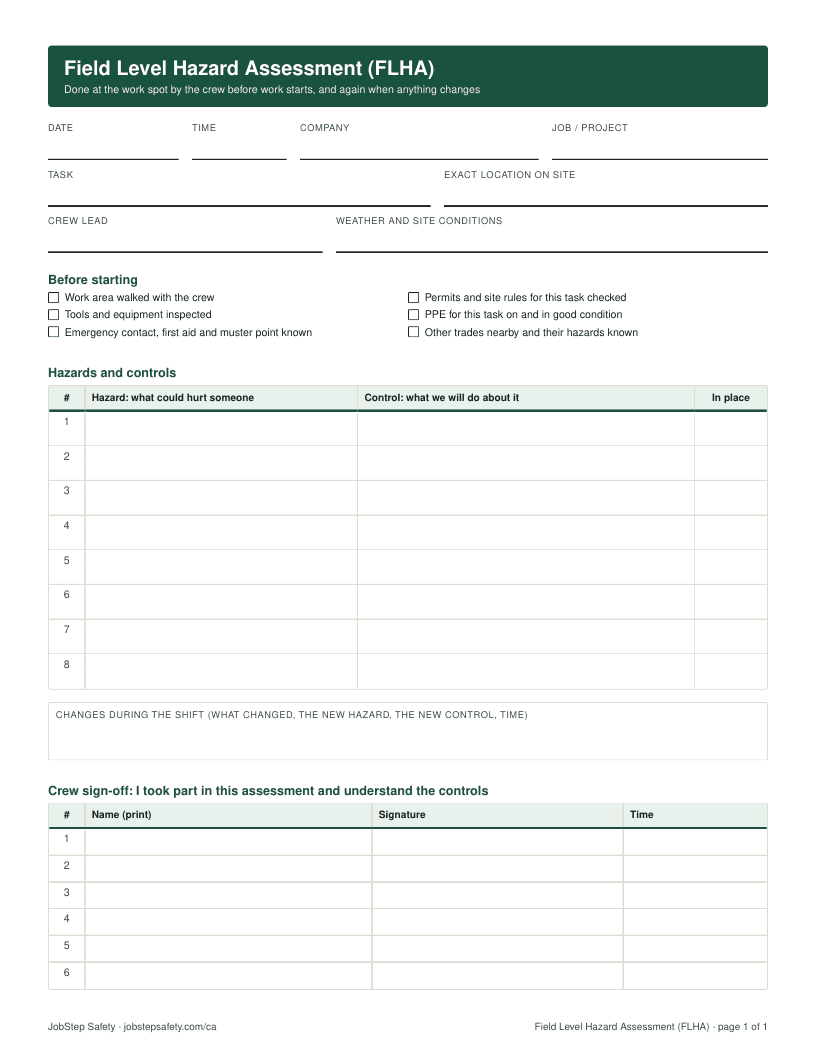
What is on the form
- Task details: date, time, company, job, task, exact location, crew lead, weather.
- Six checks before starting: area walked, permits, tools, PPE, emergency plan, other trades.
- Hazards and controls: eight lines, with a box to tick when each control is in place.
- Changes during the shift, so the assessment keeps up with the work.
- Crew sign-off with names, signatures and times.
What an FLHA is
An FLHA is a short, written hazard check done by the people about to do the work, at the spot where they will do it. It is not a replacement for planning the job. It catches what the plan could not: today's weather, the trade working above, the material dropped in the wrong place, the extra person who joined the crew this morning.
When to do an FLHA
- At the start of each task, before work begins.
- When the task changes, or a new step starts that was not on the form.
- When conditions change: weather, lighting, ground, access, other trades nearby.
- When someone new joins the crew.
- After a close call, before the work carries on.
What Alberta's hazard assessment rules say
The Alberta OHS Code does not use the term "FLHA" or "field level hazard assessment". What it requires is a hazard assessment before work begins, a dated report of it, and a repeat when the work changes. An FLHA is a common way crews do the repeat part on the job.
“An employer must assess a work site and identify existing and potential hazards before work begins at the work site or prior to the construction of a new work site.”
“An employer must prepare a report of the results of a hazard assessment and the methods used to control or eliminate the hazards identified.”
“An employer must ensure that the date on which the hazard assessment is prepared or revised is recorded on it.”
Do it again whenever the work moves on: on a regular schedule that keeps conditions from drifting, when you bring in a new way of doing the work, when a process changes, and before the site is added to or altered in a big way.
“An employer must involve affected workers in the hazard assessment and in the control or elimination of the hazards identified.”
Get rid of the hazard if you can. If not, control it in this order: engineering controls, then administrative controls, then personal protective equipment. A combination is allowed when it gives workers more protection.
Outside Alberta, this page quotes no provincial rule that names an FLHA. Many prime contractors, clients and certification programs ask for FLHAs anyway, and the same form works for that.
How to fill out an FLHA
- Fill in the top at the work spot: date, time, task, exact location, crew lead and conditions.
- Walk the area as a crew and tick the before-starting checks.
- List the hazards, one per line: what on this task, today, could hurt someone.
- Write a control for each one. Remove the hazard if you can; then guard it or change the method; PPE last.
- Read it out loud and have everyone sign.
- Keep it with you. When something changes, stop, add it to the changes box, and sign again.
A filled example: setting up temporary heat in a closed-in building
One of the 20 filled examples in the kit. The control lines come word for word from our toolbox talks.
| Hazard area | Control |
|---|---|
| Carbon monoxide from heaters and engines | Carbon monoxide (CO) is a poisonous gas you cannot see, smell or taste. It comes from anything that burns fuel without enough air: gasoline, propane, kerosene, natural gas, oil, wood. The most common workplace source is the internal combustion engine. |
| Carbon monoxide from heaters and engines | Do not run gas-powered engines or tools in poorly ventilated areas. That includes pressure washers, heaters and forklifts inside closed buildings. Where it can be done safely, switch to tools powered by electricity, batteries or compressed air, and use a personal CO monitor with an alarm when exposure is possible. |
| Temporary heaters | Carbon monoxide has no color, smell or taste. Early signs are headache, fatigue, dizziness, drowsiness and nausea, and large amounts can overcome you in minutes without warning. If you or a coworker feels that way near a heater, get to fresh air and report it. |
| Temporary heaters | If you think someone has CO poisoning, move them to fresh air in an open area right away and call 911. Do not become the second victim: rescuers can be overcome too. |
| Fire extinguishers on site | Match the extinguisher to the fire. Class A is ordinary combustibles like wood, paper and cloth. Class B is flammable liquids such as gasoline, oil and solvents. Class C is energized electrical equipment. Never put water on a flammable liquid fire or an electrical fire. |
FLHA vs JHA: what is the difference?
A job hazard analysis (JHA) is the plan: it breaks a task into steps ahead of time, lists the hazards of each step and the controls, and is reviewed when the task changes. An FLHA is the check at the work spot, on the day, against what is actually there. Crews that do both use the JHA for the steps and the FLHA for today's conditions.
Questions
Common questions
What does FLHA stand for?
Field level hazard assessment: a short hazard check done at the work spot by the crew, before the task starts and again when conditions change.
Is an FLHA required by law?
Not by that name. Alberta's OHS Code requires a hazard assessment before work begins, a dated report, and a repeat when the work changes, and many crews use an FLHA to do the repeat on site. Many prime contractors and clients also ask for FLHAs in their site rules.
How long should an FLHA take?
A few minutes for a routine task, longer for a new or high-risk one. If it takes no time at all, the crew probably did not walk the area.
Who signs an FLHA?
Everyone who does the task, including anyone who joins partway through the shift. The crew lead checks it and keeps it with the job records.
How long should FLHAs be kept?
Keep them with the job file. Your client, your certification program or your company may set a retention period; follow the longest one that applies.